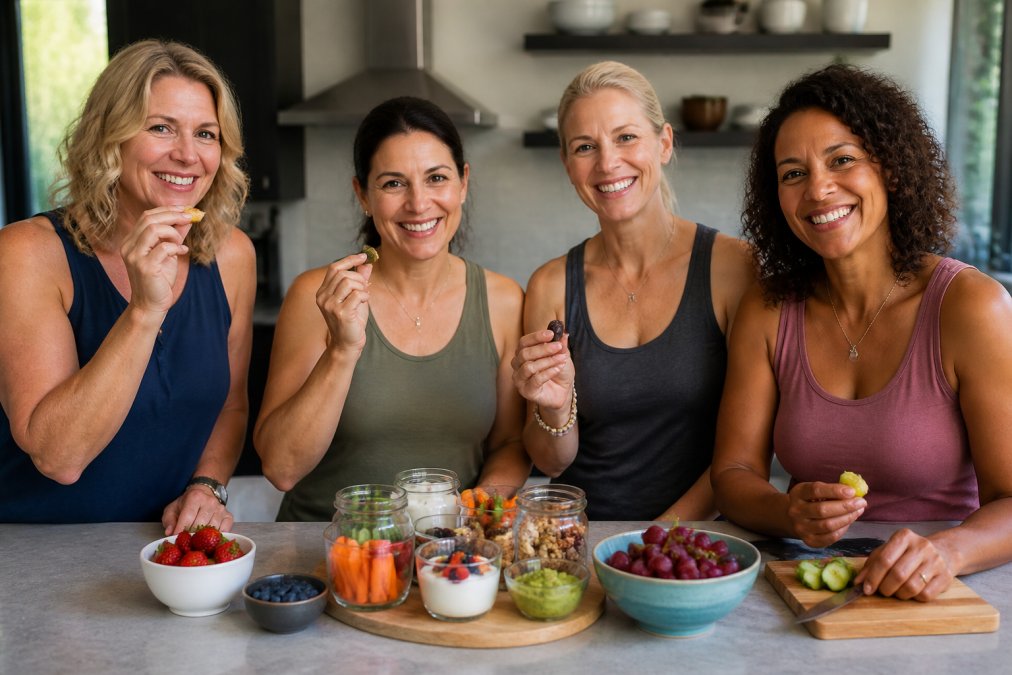
 listicle
Healthy Snacks for Weight Loss Success: 2026 Guide
Table of Contents
- Why Healthy Snacks for Weight Loss Success Fall Apart in Perimenopause
- Protein First: High Protein Snacks for Women in Their 40s and 50s
- Fibre, Healthy Fats and Blood Sugar: Building a Snack That Holds
- How to Stop Food Noise Around Snacking
- Snack Prep That Survives a Real Week
- The Snacking Belief That Keeps You Stuck
- Frequently Asked Questions
Last Updated: September 14, 2026
Why Healthy Snacks for Weight Loss Success Fall Apart in Perimenopause
You are not lacking willpower at 4pm. You are running on a hormone profile that has changed the rules, and you are still playing by the old ones. Healthy snacks for weight loss success do not fail because you picked the wrong yogurt. They fail because the snack was never the problem: the pattern underneath it was.
This guide from Coach Justine covers what actually changes in your 40s and 50s, and why the snack drawer became a battleground.
What You Have Already Tried, and Why It Did Not Hold
You have done the 100-calorie packs. The rice cakes. The "just drink water and wait twenty minutes" advice. It worked for eleven days and then a Tuesday happened.
Restriction raises the value of food. When you tell yourself a snack is forbidden, every trip past the pantry becomes a negotiation, and you are negotiating while tired, under-fuelled and running on cortisol. That is not a fair fight, and it is not a character flaw.
What most guides miss is that perimenopause changes appetite signalling before it changes your body. Sleep disruption, fluctuating estrogen and rising stress hormones all push you toward quick carbohydrate. A snack built only on willpower collapses against that; one built on protein, fibre and fat gives your body something to work with.
Protein First: High Protein Snacks for Women in Their 40s and 50s
High protein snacks for women are the single highest-use change you can make to snacking, because protein switches off hunger rather than distracting you from it.
Muscle protein synthesis becomes less responsive with age, so the same amount of protein does less work than it did at 30 (pubmed.ncbi.nlm.nih.gov). You are not just feeding hunger; you are protecting the muscle that keeps your metabolism from sliding.
How Much Protein a Snack Actually Needs
A snack needs enough protein to register as a meal, not a nibble: build toward a meaningful protein hit rather than counting crackers.
- Greek yogurt with a scoop of protein powder stirred through
- Cottage cheese with cucumber and everything seasoning
- Two hard-boiled eggs with a handful of almonds
- Turkey slices rolled around a cheese stick
- Edamame, shelled, straight from the freezer bag
Notice none of these are "diet" foods. They are just food with structure.
Fibre, Healthy Fats and Blood Sugar: Building a Snack That Holds
A snack that holds keeps blood glucose steady instead of spiking it and dropping you into a craving twenty minutes later. That means fibre, fat and protein together, not carbohydrate alone. This is the part most snack lists skip, and it decides whether you sail to dinner or stand at the cupboard at 4pm.
Fibre slows the rate at which glucose enters your bloodstream by forming a gel-like mesh in the gut that physically slows digestion. Fat slows gastric emptying, so the stomach releases its contents into the small intestine more gradually. Protein triggers satiety signalling through peptide YY and GLP-1, the same gut hormones that newer weight-management medications mimic (pubmed.ncbi.nlm.nih.gov). Stack all three and you flatten the glucose curve. Eat a piece of fruit on its own and you get a sharp rise, an insulin response, and a dip your brain reads as hunger even though you ate forty minutes ago.
Perimenopause makes this sharper, not softer. Fluctuating estrogen affects insulin sensitivity, and disrupted sleep raises cortisol, which pushes glucose up on its own (pubmed.ncbi.nlm.nih.gov). A snack that would have coasted at 35 now spikes and crashes at 47. That is not imagination. It is physiology changing the rules mid-game.
Snack Combinations That Steady Energy
| Base | Add Fat | Add Fibre | Approximate Protein | Why It Holds |
|---|---|---|---|---|
| Plain Greek yogurt (170g) | Walnuts (15g) | Raspberries (80g) | 17g | Protein plus fat plus fibre, steady for three to four hours |
| Apple | Almond butter (1 tbsp) | Skin on | 4g | Fibre and fat slow the fruit sugar |
| Cottage cheese (150g) | Olive oil drizzle | Cherry tomatoes | 18g | Savoury, satisfying, low effort |
| Hummus (4 tbsp) | Olive oil | Carrot and pepper sticks | 5g | Plant protein with crunch and volume |
| Two hard-boiled eggs | Quarter avocado | Celery | 12g | Fat and protein, almost no carb load |
| Edamame (1 cup, shelled) | Sesame oil drizzle | The beans themselves | 17g | Complete plant protein plus fibre in one item |
The pattern matters more than the exact foods. Swap any row for something you will actually eat and the principle holds. What does not hold is a snack built on rice cakes, low-fat crackers, or a banana on its own, because none carry enough protein or fat to blunt the glucose response.
Learn more about HER Aligned here →
The Blood Sugar Signal You Are Probably Missing
If you finish a snack and feel hungry again within the hour, the snack failed on composition, not quantity. That is the signal to watch. It is not that you lack discipline; the food you chose did not give your body anything to work with.
A common pattern I see in clients is a mid-afternoon crash they blame on willpower. They ate a "healthy" snack at 3pm, felt ravenous by 3:45, and concluded they have no self-control. In reality they ate carbohydrate with no protein anchor, their glucose spiked and dropped, and their brain demanded quick energy. The fix is not more discipline. It is a different snack.
Food tracking, done with curiosity rather than judgement, is often how women first see this pattern in their own week. It is not about policing yourself. It is about noticing that the days you feel steady are the days you ate this way, and the days you feel out of control are the days you did not. That is information, not a verdict.
How to Stop Food Noise Around Snacking
Learning how to stop food noise starts with accepting that food noise is not hunger, and it will not respond to food. It responds to being named, understood and separated from your actual physical state. This is the angle most snack articles avoid entirely, because it is easier to publish a list of almonds than to talk about why you are standing at the cupboard at 9pm when you are not hungry.
Food noise is the background hum of thinking about food: what is in the cupboard, what you will have later, whether you have been "good" today, whether you have already ruined it. It gets louder when you are tired, stressed, or have been restricting. It is not a character flaw or a lack of willpower. It is your nervous system looking for regulation, and food is the fastest route it knows.
The Three Triggers Behind Most Snacking in Perimenopause
Most snacking that is not physical hunger comes from one of three places. Naming which one is yours is the work.
Stress and cortisol. When you are running on cortisol, your body preferentially reaches for quick carbohydrate because it is trying to refuel fast. This is not weakness. It is a survival response that made sense when stress meant running from something. It makes less sense when stress means an inbox, but your body did not get the memo. Perimenopause amplifies this because cortisol and estrogen are in constant conversation, and when one shifts, the other follows.
Emotional regulation. If you have spent thirty years using food to soften a hard day, that pattern does not disappear because you decided on Sunday that it should. It is a learned skill, and it needs to be unlearned with something else in its place. This is where trauma-informed mindset work matters, because the pattern is often older than the snacking itself.
Restriction rebound. If you have been under-eating through the day to "save calories," the evening is not a failure of willpower. It is biology collecting a debt. The body does not care about your deficit. It cares about being fed.
Physical Hunger or Food Noise? Telling Them Apart
Ask these questions honestly:
- Would an apple or eggs do? If only something specific will do, that is noise, not hunger.
- When did you last eat, and did that meal have protein? Physical hunger builds gradually. Noise arrives suddenly, often mid-task.
- Are you actually tired, thirsty, bored, or avoiding something? Most snacking at 3pm is one of those four.
- Does eating it actually satisfy you, or are you back at the cupboard ten minutes later? Noise does not close the loop.
- If you sat with the urge for five minutes without eating, would it pass or intensify? Physical hunger intensifies. Noise often fades once it is noticed.
Hydration and electrolytes matter here too. Mild dehydration reads as hunger and fatigue, and perimenopausal women lose fluid regulation efficiency, so thirst is a less reliable signal than it used to be. A glass of water with a pinch of salt is not a snack replacement, but it is often worth trying before you open the cupboard.
What Actually Changes the Pattern
Naming the trigger is step one. Changing it is step two, and step two is where most women get stuck, because the pattern is not in the snack drawer. It is in how you respond to stress, to boredom, to the end of a long day, to the part of you that believes food is the only reliable comfort you have.
That is not a problem a snack list solves. It needs structure, accountability and someone who can see the pattern you cannot see from inside it. I have watched hundreds of women try to fix this with a better grocery list, and the grocery list was never the missing piece.
Learn more about HER Aligned here →
Snack Prep That Survives a Real Week
Snack prep works when it takes twenty minutes and does not require you to be a different person on Sunday than you are on Wednesday.
The version that survives a real week looks like this:
- Buy three proteins in bulk: Greek yogurt, cottage cheese, hard-boiled eggs.
- Wash and cut vegetables once, store them in water in the fridge so they stay crisp.
- Portion nuts into small containers so you are not guessing from the bag.
- Keep one savoury and one sweet option ready, because you will want both.
- Accept that a chaotic week means a simpler snack, not no snack.
Budget matters too, and this way of eating is cheaper than most diet products. Eggs, plain yogurt, frozen berries, tinned fish, carrots and hummus cost less per serving than the protein bars marketed at you.
The Snacking Belief That Keeps You Stuck
The belief keeping you stuck is this: that you need the perfect snack plan before you can trust yourself around food.
That belief is why you have downloaded apps, bought the bars, followed the plans, and ended up back at square one. The plan was never the missing piece. Your relationship with food, and the patterns driving your choices, were.
I have watched this play out in hundreds of women. Someone follows a snack list perfectly for three weeks, has one unplanned evening, decides she has ruined it, and abandons the whole thing. That is not a snack problem. That is all-or-nothing thinking wearing a snack costume.
Simone lost 20kg and 22cm from her waist, and the turning point was not a better snack list. It was learning to keep going after an imperfect day instead of restarting. Angela lost 13kg in 15 weeks through menopause with the same shift.
If you are in your early 40s and unsure whether you are even in perimenopause yet, you do not need to wait for worse symptoms. The patterns are already there, and they are easier to change now than after five more years of starting over.
The real challenge is not finding healthy snacks for weight loss success. It is breaking the cycle that makes you abandon them the moment life gets messy. That takes structure, accountability and someone who can see the pattern you cannot, which is exactly what Coach Justine provides: 12 years coaching perimenopausal women, a 95% success rate, and a focus on the thinking underneath the eating rather than another list of foods. Start with the free Peri Protocol assessment to see which pattern is keeping you stuck, or apply for 1:1 coaching and build a way of eating that holds through a real week, not a perfect one.
Frequently Asked Questions
Is snacking necessary for weight loss success?
No. Snacking is not required for fat loss, and three solid meals can work well if they keep you full. What matters is what the snack does for your hunger and energy across the day. If you go five or six hours between meals and arrive at dinner ravenous, a planned snack built on protein and fiber steadies that. If snacking has become something you do without hunger, that is food noise, not need, and it is worth examining before adding more snacks.
Why do I feel hungry even after eating a healthy snack?
Most often the snack was carbohydrates on their own: a piece of fruit, a rice cake, a handful of crackers. Those digest quickly and blood sugar dips again within an hour or two. Add protein and fat to the same snack, such as Greek yogurt with berries, or apple with peanut butter, and you change how long it holds. Perimenopause also shifts appetite signals, so a snack that worked at 35 may not be enough at 48.
How can I distinguish between physical hunger and food noise?
Physical hunger builds gradually, comes with body signals like an empty feeling or low energy, and any real food sounds good. Food noise arrives suddenly, often after a stressful email or a difficult conversation, and it wants something specific: the chocolate, the crisps, the biscuits. Try the apple test. If an apple would not touch it, you are not hungry. That distinction is the first step in how to stop food noise, because you cannot change a pattern you keep mistaking for hunger.
What role does protein play in managing cravings for women over 40?
Protein takes longer to digest and supports muscle, which matters more after 40 because muscle mass declines faster in perimenopause. A snack with 15 to 25 grams of protein, such as cottage cheese, Greek yogurt, hard-boiled eggs or turkey slices, keeps you full for longer and reduces the pull toward refined carbohydrates an hour later. Protein also supports blood sugar regulation, so the afternoon crash that sends you hunting for sugar becomes far less common.