 how-to
Overcoming Self-Sabotage in Weight Loss: A Step-by-Step Guide
Table of Contents
- What Self-Sabotage in Weight Loss Actually Looks Like
- Understanding Emotional Eating Triggers
- Identifying Your Negative Thought Patterns
- Weight Loss Mindset Shifts That Actually Work
- How to Stop Binge Eating and Break the Restriction Cycle
- Building Self-Compassion in Weight Loss
- Your Action Plan to Stop Self-Sabotage for Good
Last Updated: August 12, 2026
What Self-Sabotage in Weight Loss Actually Looks Like
Self-sabotage in weight loss isn't something that happens to you, it's something you do to yourself, often without realizing it. You start the week with genuine commitment, then find yourself binge eating on Wednesday night. You nail your workouts for three weeks, then mysteriously "forget" to go for the next two. You know what you need to do, but something inside keeps pulling you backward.
This pattern is incredibly common, especially for women navigating perimenopause. Your body is changing, your hormones are shifting, and the strategies that worked five years ago suddenly feel impossible. That's not weakness, that's your brain and body working against your conscious goals.
At Coach Justine, we've worked with hundreds of women stuck in this exact loop. The ones who break free aren't necessarily the ones with the best meal plans or the most disciplined workout schedules. They're the ones who understand what's actually driving their self-sabotaging choices. Once you see the pattern clearly, you can interrupt it.
Self-sabotage shows up predictably: restricting food all day then overeating at night, committing to workouts then talking yourself out of them, losing weight then immediately gaining it back, or starting strong on Monday and quitting by Friday after one slip-up. The key insight: these aren't character flaws. They're habit loops with emotional, psychological, and sometimes physiological roots. Understanding the roots is how you actually change the pattern.
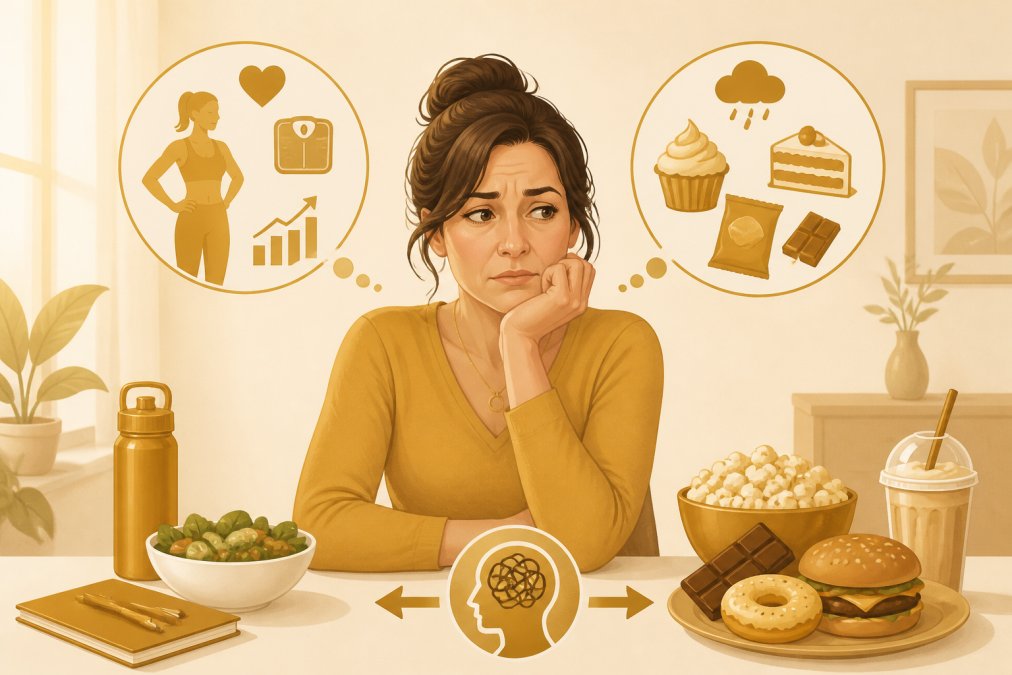
Understanding Emotional Eating Triggers
Emotional eating happens when you eat to manage feelings rather than physical hunger. Your nervous system needs regulation, and food becomes your coping tool for stress, boredom, loneliness, anxiety, or even success.
When you experience a difficult emotion, your brain searches for the fastest way to feel better. For many women, that's food. It works, it actually does make you feel better, temporarily. Your brain remembers this, and the next time that emotion shows up, it automatically suggests the same solution.
Common triggers include work stress, relationship conflict, perfectionism (when you've "failed," food numbs the shame), boredom, fatigue, and even positive emotions like celebration. Some women eat more during their luteal phase, when progesterone naturally increases appetite and reduces serotonin.
The problem isn't the emotion, it's that food becomes your primary coping strategy. Over time, you stop noticing the actual emotion and only notice the urge to eat.
What changes things: developing alternative ways to regulate your nervous system. This might include deep breathing, movement, talking to someone, taking a warm bath, or simply sitting with the emotion for five minutes without reaching for food. These alternatives take practice, your brain has learned that food works, but with repetition, you can build new pathways.
One practical step: the next time you feel an urge to eat when you're not physically hungry, pause and name the emotion first. "I'm stressed about that meeting." "I'm bored right now." This simple act of naming interrupts the automatic pathway and gives your conscious mind a chance to choose differently.
Identifying Your Negative Thought Patterns
Your internal monologue drives your behavior far more than willpower ever could. If you're constantly telling yourself "I'm bad at this" or "I'll never stick to anything," your brain will find ways to prove you right.
Common negative thought patterns include all-or-nothing thinking ("I had one cookie, so I've ruined everything"), catastrophizing ("If I gain back two pounds, I'll end up back where I started"), and personalization ("The fact that I slipped up means I'm fundamentally broken").
All-or-nothing thinking is particularly destructive. You're either "on plan" or "off plan," "being good" or "being bad." There's no middle ground where you're simply a person making choices, some aligned with your goals and some not. This binary thinking makes it impossible to recover from small missteps.
The shift that matters: moving from "I am bad at this" to "I'm learning how to do this differently." The first is permanent and character-based. The second is temporary and skill-based. You can improve a skill.
Start noticing your thought patterns without judgment. What do you tell yourself when you slip up? What do you believe about your ability to change? Once you notice the pattern, you can question it: "Is this actually true, or is this just what I've always believed?"
Weight Loss Mindset Shifts That Actually Work
Overcoming self-sabotage requires shifting from a scarcity mindset to an abundance mindset. When you approach weight loss from restriction and deprivation, your brain rebels. It focuses on what you're missing, which intensifies cravings and makes the whole experience feel punishing.
An abundance mindset asks "What can I add?" instead of "What do I have to remove?" This might mean adding more protein to keep you satisfied, adding movement you actually enjoy, or adding stress management practices that make restriction unnecessary.
The identity shift is equally important. Most people try to change behavior without changing identity. They try to "be someone who works out" while identifying as "someone who's never been athletic." This creates internal conflict that usually results in self-sabotage.
Instead of "I'm trying to lose weight," it becomes "I'm someone who takes care of myself." Instead of "I'm on a diet," it becomes "I make choices that honor my body." When your identity aligns with your goals, the behaviors follow naturally.
Another crucial shift: from motivation-dependent to systems-dependent. Motivation is unreliable. Systems are reliable. A system might be "I eat protein at every meal" or "I move my body for 20 minutes before work." Systems don't require motivation, they just require one decision, then repetition.
Finally, shift from perfection to consistency. Perfection is impossible and unnecessary. Consistency is what creates results. You don't need to be perfect, you need to be consistent enough that your aligned choices outnumber your misaligned choices over time.
How to Stop Binge Eating and Break the Restriction Cycle
The restriction-binge cycle is one of the most frustrating patterns in weight loss. You restrict during the day, your body fights back, and by evening you're binge eating. Then you feel guilty, so you restrict even more the next day. The cycle intensifies.
This cycle isn't a character problem, it's a biological response. When you restrict food, your body increases hunger hormones and decreases satiety hormones. Your brain is literally being told it's starving, so it pushes you toward food.
Breaking this cycle requires addressing both sides: the restriction and the emotional component. First, eat enough. If you're not eating enough protein, carbs, or overall calories, your body will fight you. Many women accidentally eat too little, which triggers intense cravings and binge episodes.
Second, build awareness around the emotional component. What happens right before a binge? Are you stressed? Tired? Lonely? Once you know your triggers, you can address them directly instead of through food.
Third, practice "flexible restraint" instead of rigid restriction. You have guidelines, not rules. This prevents the deprivation that triggers binges while keeping you generally on track.
If you do binge, the response matters enormously. Many women respond with guilt and increased restriction, restarting the cycle. A more effective response: notice it without judgment, understand what triggered it, and return to your normal eating pattern the next meal. One binge doesn't erase your progress.
One practical tool: the "pause practice." When you feel an urge to binge, pause for five minutes. Drink water. Take deep breaths. Check in with what you're actually feeling. Often, the urge will pass, and you can make a conscious choice instead of acting automatically.
Learn more about HER Aligned here →
Building Self-Compassion in Weight Loss
Self-criticism is one of the most powerful drivers of self-sabotage. When you slip up, your internal response determines whether you get back on track or spiral further. If your response is harsh self-judgment, you're more likely to give up. Your brain enters a shame spiral, and food often becomes a way to numb that shame.
Self-compassion is different. It means treating yourself the way you'd treat a good friend who's struggling. You'd be understanding. You'd acknowledge that struggle is normal. You'd encourage them to try again tomorrow.

Self-compassion doesn't mean abandoning your goals. It means being honest about your struggles while still believing in your ability to change. Setbacks are information, not failure.
When you notice self-criticism, pause and reframe it. Instead of "I'm so lazy for skipping my workout," try "I'm tired today, and that's okay. I can move my body tomorrow." Instead of "I have no willpower," try "I'm learning how to make choices that honor my body, and this is part of the learning process."
Mindfulness supports this shift. When you notice difficult emotions without immediately trying to fix them, you create space for self-compassion. You're not trying to be perfect, you're trying to be human, imperfect, and worthy of kindness anyway.
This is where many traditional diet approaches fail. They're built on shame and restriction, which actually increase self-sabotage. Approaches built on self-compassion create lasting change because they address the root patterns instead of just surface behaviors.
Your Action Plan to Stop Self-Sabotage for Good
Understanding self-sabotage is the first step. Creating a concrete action plan is what actually changes your behavior.
Step 1: Identify Your Personal Sabotage Pattern
Your self-sabotage probably has a signature. Maybe you start strong, then quit when things get hard. Maybe you lose weight, then gain it back. Maybe you binge when stressed. Spend a week noticing without trying to change anything. What's your pattern?
Write it down: "When I'm stressed, I eat at night." "When I lose five pounds, I sabotage by eating more the next week." Naming the pattern is half the battle.
Step 2: Identify the Emotion or Need Underneath
For each sabotage pattern, ask: what emotion or need is being met? If you binge when stressed, stress relief is the need. If you quit workouts when tired, rest or permission to slow down is the need.
Understanding the need is crucial because you can then meet it differently. If you need stress relief, you can take a walk, call a friend, or take a bath instead of eating. If you need permission to rest, you can give yourself that permission without guilt.
Step 3: Build Alternative Coping Strategies
For each sabotage pattern, identify 2-3 alternative ways to meet the underlying need. Write these down and post them somewhere visible.
Examples:
- If you eat when stressed: take a 10-minute walk, call someone, do a guided breathing exercise
- If you quit when tired: do a shorter workout, take a full rest day, or adjust your expectations
- If you binge after restricting: eat more regularly during the day, allow more flexibility, practice the pause practice
Step 4: Create a Tracking System
You don't need to track calories. You do need to track your patterns. This might be as simple as a note on your phone each day: "Did I follow my plan? If not, what happened?" Over time, you'll see which strategies work for you.
Many women find that tracking their cycle alongside eating and energy patterns reveals important information. Some have stronger cravings during their luteal phase. Understanding this isn't about judging yourself, it's about adjusting your expectations accordingly.
Step 5: Build Accountability and Support
Self-sabotage thrives in isolation. When you're working alone, it's easy to talk yourself into just one more slip-up. Accountability changes this. This might be a friend, a coach, or a community of people working toward similar goals.
The accountability isn't about judgment, it's about having someone who sees your patterns, believes in your ability to change, and gently holds you accountable to your own goals. If you're ready to dive deeper into your specific patterns, the Free Peri Protocol is a helpful starting point to understand how your body and hormones are influencing your choices.
The journey toward overcoming self-sabotage in weight loss is fundamentally about understanding yourself more deeply. Your struggles aren't character flaws, they're patterns you've developed, and patterns can be changed. The women who succeed are the ones who understand their patterns and commit to changing them.
If you've been stuck in cycles of restriction and binge eating, perfectionism and failure, or weight loss and regain, the missing piece is usually understanding what's driving those cycles. The HER Aligned Coaching Membership is designed to help women identify and overcome the psychological patterns and behavioral habits that create self-sabotage. Through evidence-based coaching addressing both mindset and nutrition, you can break these cycles for good, not with another diet, but by changing the thinking and behavioral patterns underneath your choices.
Frequently Asked Questions
How do I stop self-sabotaging my weight loss?
Start by identifying your specific triggers—stress, boredom, perfectionism, or past diet failures. Once you know what sets off the sabotage cycle, you can interrupt it. The key is self-compassion, not willpower. When you slip, acknowledge it without shame, understand what triggered it, and move forward. Most women find that addressing the underlying beliefs and emotions driving the behavior is far more effective than relying on restriction or willpower alone.
What's the difference between a bad day and actual self-sabotage?
A bad day is one slip or choice that doesn't align with your goals. Self-sabotage is a pattern—repeated choices that undermine your progress, often driven by limiting beliefs or emotional regulation struggles. Self-sabotage typically involves an 'all-or-nothing' mindset where one mistake becomes permission to abandon your goals entirely. If you notice yourself repeatedly cycling through restriction and binge eating, or consistently choosing behaviors that contradict your stated goals, that's sabotage worth addressing.
How does emotional eating connect to self-sabotage in weight loss?
Emotional eating is often a coping mechanism—you use food to manage stress, anxiety, boredom, or shame. When you haven't addressed the underlying emotion, you keep returning to food for comfort, which sabotages your progress. The cycle deepens when shame about eating triggers more emotional eating. Breaking this requires learning to identify emotions, regulate them without food, and practice self-compassion when you do reach for food emotionally. This is why mindset work matters as much as nutrition does.
Can I really keep weight off long-term, or will I always gain it back?
You can keep it off—but only if you address the patterns underneath your choices. Most women regain weight because they return to old thinking patterns and behaviors once the 'diet' ends. Lasting change comes from shifting your identity and beliefs about yourself, building sustainable habits that fit your real life, and developing self-trust. This isn't about perfection; it's about consistency and knowing how to get back on track when life happens. That's why the focus is on changing your relationship with food and yourself, not just following a plan.