 how-to
Stop Food Obsession and Guilt: Break the Cycle
Table of Contents
- You've Tried Everything, and It Keeps Coming Back
- Food Noise in Perimenopause: Why Your Brain Won't Shut Up About Food
- The Root Cause: Restriction, Not Appetite
- Breaking the Yo-Yo Dieting Cycle Starts with Understanding Why You're Stuck
- Emotional Eating and Food Guilt: The Pattern That Keeps You Trapped
- Rebuilding Trust with Food and Yourself
- Why This Needs Real Structure, Not Another App
- Frequently Asked Questions
Last Updated: September 23, 2026
You've Tried Everything, and It Keeps Coming Back
You've done the diets. The apps. The meal plans. You've counted calories, tracked macros, joined challenges, hired personal trainers, seen dieticians. For a while it works. Then something shifts. The food noise starts again. The guilt creeps back. You're back where you started, wondering why nothing helps you stop food obsession.
This isn't a willpower problem. It's not that you lack discipline or that you're broken. The real issue is that you're treating the symptom, not the cause. At Coach Justine, we've worked with over 600 perimenopausal women caught in this exact cycle, and the pattern is always the same: restriction creates obsession. Obsession creates guilt. Guilt creates more restriction. Until you break that loop, no app or meal plan will save you.
The good news? You can stop food obsession and guilt. But it requires understanding why it started in the first place.
Food Noise in Perimenopause: Why Your Brain Won't Shut Up About Food
Food noise is constant, intrusive thinking about food. It's not hunger. It's the mental chatter that won't quit, the urge to eat even when you're full, the obsession with what you'll eat next, the guilt about what you just ate.
In perimenopause, your oestrogen is dropping. That hormone regulates serotonin, dopamine, and appetite signalling. When oestrogen falls, your brain becomes more reactive to food cues. You see food and your brain lights up differently than it did at 30. That's not weakness. That's neurobiology.
Food noise isn't caused by hunger or lack of willpower alone. It's caused by restriction, but it's also being actively amplified by the environment you're consuming every day.
When you open Instagram or TikTok, you see wellness influencers promoting "clean eating challenges," before-and-after transformations, meal prep, and "accountability" posts about avoiding "bad foods." Your brain registers this as social proof that restriction is normal, that food is something to be controlled, that certain foods are dangerous. The algorithm is designed to show you content that triggers engagement, and food guilt and food obsession are highly engaging emotions.
Then you see the opposite: the "intuitive eating" influencer posting about eating "whatever you want" with no consequences. This contradiction creates cognitive dissonance. You're being told simultaneously that food is dangerous and that food is freedom. Both messages increase food noise because your brain is trying to reconcile two opposing frameworks.
Diet culture has spent decades telling you that certain foods are "guilty pleasures," that you need to "earn" food through exercise, that your body is something to be controlled and punished. These messages feel like truth, not conditioning. But they're conditioning. In perimenopause, when your oestrogen is already making your brain more reactive to food cues, this conditioning becomes louder.
A meta-analysis in Nutrients found that exposure to diet culture messaging and weight-loss content on social media is associated with increased disordered eating behaviours and body dissatisfaction. More importantly, guilt and shame created by diet culture messaging actually increase food obsession. Restriction, whether from a meal plan or internalised diet culture beliefs, creates scarcity. Scarcity creates obsession.
When you're sitting with food noise in perimenopause, you're dealing with the neurobiological reality of dropping oestrogen, years of conditioning that food is something to be feared or controlled, daily exposure to contradictory messaging, and an algorithm that profits from your food guilt.
Break the restriction, and the obsession quiets down. But you also need to break the conditioning. Be intentional about the content you consume. Unfollow accounts that make you feel guilty about food. Recognise that "wellness" advice is often diet culture repackaged. Your food noise isn't a personal failing; it's a predictable response to a system designed to keep you obsessing about food.
The Root Cause: Restriction, Not Appetite
Most women believe the problem is that they eat too much or want food too badly. So they restrict harder, cut calories, eliminate food groups, create rules. This is exactly backwards.
Restriction is the accelerant. When you label foods as "good" or "bad" and create rigid rules, your brain treats those foods as scarce. Scarcity triggers obsession. It's the same reason you want something more the moment someone tells you that you can't have it.
Over 12 years of coaching women through this, the pattern is consistent: the women with the loudest food noise are often the ones with the strictest rules. Not because they lack discipline, but because their brains are wired to want what they've been told is forbidden.
Restriction also creates a metabolic and psychological stress response. Your body senses deprivation and cranks up hunger signals, cravings, and food obsession. It's trying to protect you. Break the restriction, and within weeks the mental chatter starts to fade. The cravings become manageable. Food stops being the enemy.
Breaking the Yo-Yo Dieting Cycle Starts with Understanding Why You're Stuck
You're stuck because every time you try to lose weight, you swing back to restriction. Restriction works for a while, then fails. You gain the weight back. So you restrict again, harder. Each cycle makes it worse because your brain learns that restriction is coming and amplifies the food noise in anticipation.
Breaking it requires asking different questions: "Why am I using food to cope with emotion? Why do I need rigid rules to feel in control? What belief about myself keeps me stuck in this pattern?" Until you answer these, you'll keep cycling.
Emotional Eating and Food Guilt: The Pattern That Keeps You Trapped
Emotional eating isn't about the food. It's about what the food does for you: it numbs, soothes, and gives you control when everything else feels chaotic. You're stressed about work, so you eat. You feel lonely, so you eat. You're exhausted from managing everyone else's needs, so you eat. In the moment, food calms your nervous system.
Then the guilt hits. You feel like you've failed and spiral into negative self-talk. Tomorrow you restrict and eat "clean." But the emotion underneath hasn't changed. You're still stressed, still lonely, still exhausted. So the cycle repeats.
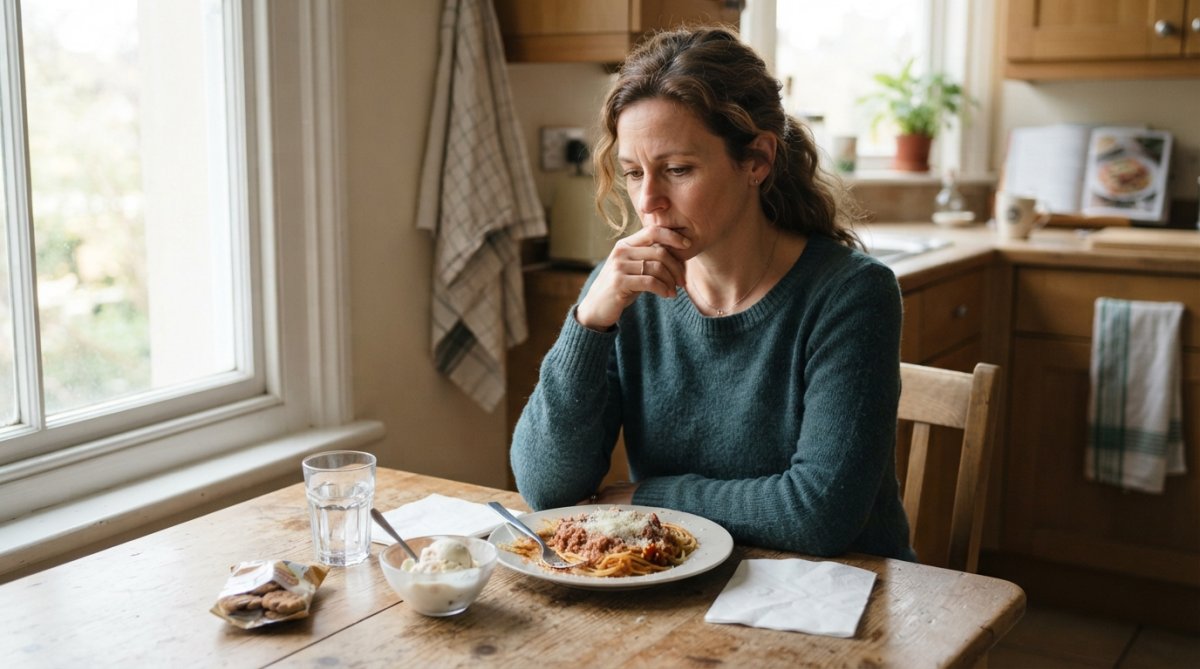
Guilt is the real problem. Guilt creates shame, shame creates secrecy, and secrecy creates more emotional eating because now you're eating to numb the shame of eating.
Breaking this pattern requires two things. First, stop labelling foods as "good" or "bad." Food is food. Eating it doesn't make you good or bad. Second, develop other ways to regulate emotion that work in the moment when the urge to eat hits.
When you feel the urge to eat but you're not physically hungry, pause and name the specific emotion first.
Rebuilding Trust with Food and Yourself
Trust is broken when you've spent years telling yourself you'll do something and then not doing it. Each broken promise erodes your trust in yourself. Food becomes part of that broken trust.
Why This Needs Real Structure, Not Another App
You already know what to do. Eat balanced meals. Move your body. Sleep. Manage stress. Stop emotional eating.
Frequently Asked Questions
How do I distinguish between physical hunger and emotional food noise?
Physical hunger builds gradually and can be satisfied with any food. Emotional food noise is sudden, specific (you want that one thing), and doesn't ease when you eat. Physical hunger comes from your body; food noise comes from your mind replaying restriction, guilt, or unmet emotional needs. Notice whether you're thinking about food because you haven't eaten enough, or because you're avoiding something else entirely. This awareness is the first step to breaking the cycle.
Why does perimenopause increase food noise and obsession?
The drop in oestrogen during perimenopause affects appetite regulation and blood sugar stability, making hunger signals less predictable. But food noise itself isn't just biology. Years of restriction, diet mentality, and perfectionism create obsessive thought patterns that intensify when your body is already dysregulated. You're not broken; you're dealing with both a hormonal shift and learned patterns that need unlearning. That's why standard nutrition advice alone doesn't work.
How does shifting mindset patterns reduce food obsession?
Food obsession thrives on the belief that some foods are forbidden and willpower is the answer. When you shift from 'I can't have this' to 'I can choose what serves me,' the scarcity mindset dissolves. Cognitive behavioural patterns like all-or-nothing thinking fuel restriction and guilt cycles. By identifying and challenging these patterns, you stop the mental loop that keeps food front and centre. The obsession fades when food is no longer the battleground for perfectionism and control.
What's the difference between food guilt and disordered eating patterns?
Food guilt is a learned emotional response to eating certain foods, usually rooted in diet mentality and perfectionism. Disordered eating patterns involve distorted relationships with food that affect physical and mental health significantly, such as binge eating disorder or restrictive eating. Guilt alone doesn't define a disorder, but when guilt drives restriction, which triggers binges, which triggers shame, you're in a cycle that needs professional intervention. If you're caught in that loop, a trauma-informed coach who works alongside healthcare providers is essential.
You've tried the quick fixes. You know they don't work. What you need now is to understand why you're stuck and to build the skills and self-trust that actually create lasting change. The next step is to take the free assessment to see exactly where you are in the cycle and what's keeping you there. From there, you can decide whether HER Aligned Coaching Membership or 1:1 coaching is the right fit for you.