 how-to
Weight Loss Meal Planning for Beginners That Actually Lasts
Table of Contents
- Why Meal Planning Feels Impossible (And Why It's Not Your Fault)
- The Real First Step in Weight Loss Meal Planning for Beginners: Awareness, Not Rules
- Managing Food Noise: How to Quiet the Constant Chatter About Food
- What a Beginner Meal Plan Actually Looks Like (Without the All-or-Nothing Trap)
- The 7-Day Meal Planning Framework I Use With My Perimenopause Clients
- Why Your Last Meal Plan Failed: The Psychology of Consistency
- Your Next Step: Move From Planning on Paper to Planning That Sticks
- Frequently Asked Questions
Last Updated: September 7, 2026
You have tried every diet, every app, every 7-day plan. You follow the meal plan perfectly for four days, then life happens, the wheels fall off, and you are back to square one. This is not a discipline problem. Weight loss meal planning for beginners fails not because the recipes are wrong, but because the approach ignores how your brain works around food.
After 12 years coaching women through perimenopause, I have seen many clients cycle through this exact pattern. The meal plan was never the problem. You were handed a rigid structure designed for someone without your stress, your schedule, or your history of yo-yo dieting. This guide shows why meal planning for beginners keeps collapsing, and what actually needs to change.
Why Meal Planning Feels Impossible (And Why It's Not Your Fault)
You do not lack willpower. You lack an approach that accounts for the fact that you are a busy perimenopausal woman with real-life demands, not a controlled study participant. Most beginner meal plans assume you will happily eat grilled chicken and broccoli five times a day while managing work, kids, and exhaustion. That assumption is where everything breaks down.
Your brain is wired to resist restriction. When a plan tells you what you cannot have, it triggers the exact psychological response that makes you crave it more. The all-or-nothing trap convinces you that one biscuit ruins the entire day, so you may as well eat the whole packet and start again on Monday. The plan is failing you by demanding perfection that no real woman can sustain.
The Real First Step in Weight Loss Meal Planning for Beginners: Awareness, Not Rules
Before you write a single shopping list, you need to understand what is driving your current food choices. Nutritional awareness for women is not about calorie counting or weighing every portion. It is about noticing the patterns underneath your eating without judgement.
Start by tracking what you eat, not to restrict, but to observe. For one week, write down everything, including the times, the triggers, and the emotions present. You will likely notice patterns that surprise you, like the 3pm chocolate run that has nothing to do with hunger and everything to do with an energy crash.
A common mistake is skipping straight to the meal plan because it feels productive, when you are just repeating the same cycle with different recipes. Understanding your current patterns is the foundation that makes weight loss meal planning for beginners sustainable.
Managing Food Noise: How to Quiet the Constant Chatter About Food
Food noise is the constant mental chatter about what you should or should not eat, what you ate earlier, and what you will allow yourself later. For many perimenopausal women, this noise is exhausting and relentless. It steals mental energy and makes every food decision feel like a battle.
The chatter is amplified by hormonal changes during perimenopause, alongside years of dieting that have trained your brain to obsess over food. When you constantly restrict, your brain perceives food as scarce, and scarcity drives obsession.
The way out is building trust with yourself around food. This means eating regular, satisfying meals that include the foods you enjoy, so your brain stops treating every treat as a last chance. When food becomes neutral rather than forbidden, the noise begins to quiet. You cannot sustain any plan while your brain is in survival mode fighting against it.
What a Beginner Meal Plan Actually Looks Like (Without the All-or-Nothing Trap)
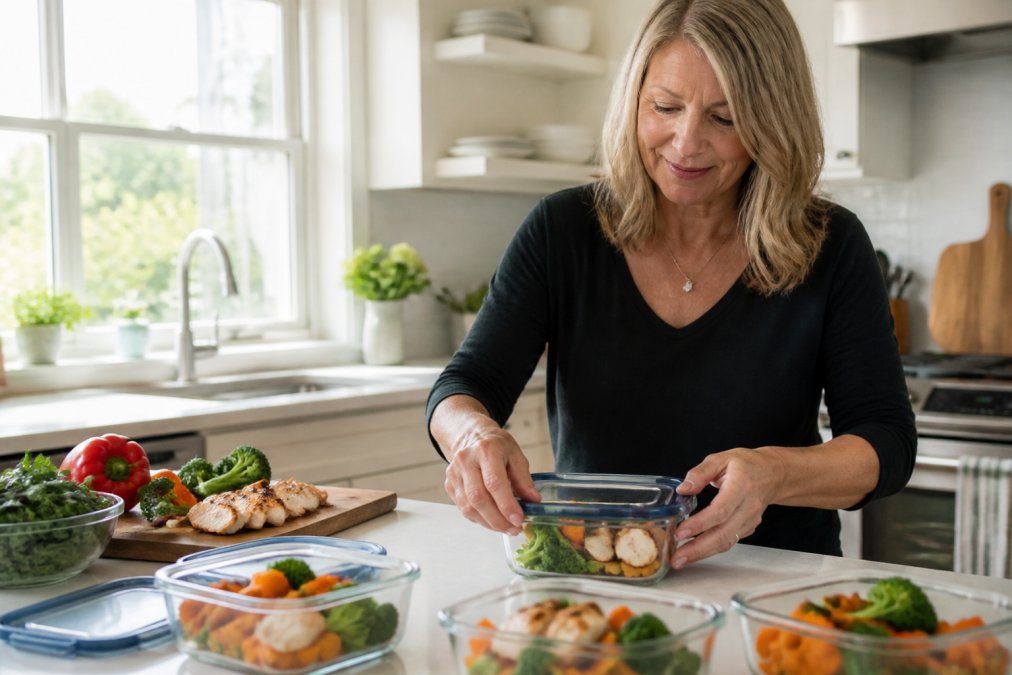
A sustainable beginner meal plan is not a rigid prescription, it is a flexible framework built around consistency, not perfection. The goal is to eat balanced meals most of the time, without demanding that every single meal be flawless.
The structure needs to be concrete enough that you are not guessing at every meal. Guessing is where the wheels come off, because an ambiguous plan forces you to make decisions when you are hungry and tired, which is exactly when your brain defaults to whatever is fastest.
The Plate Method: Your Portion Control Shortcut
Forget weighing every gram of food. The most sustainable portion control strategy for beginners is the plate method, which the United States Department of Agriculture's MyPlate framework popularised. You do not need a food scale, you need a standard dinner plate, roughly 25 to 27 centimetres across.
Fill it like this:
- Half the plate with non-starchy vegetables. Think broccoli, spinach, peppers, courgette, green beans, or a salad. These provide volume and fibre for roughly 100 to 150 calories per generous serving, which keeps you full without spiking blood sugar.
- A quarter of the plate with lean protein. For a woman in perimenopause, protein needs are higher than popular diet culture suggests. Aim for 25 to 35 grams of protein per meal to preserve muscle mass, support metabolic rate, and keep you satisfied for four to five hours. That looks like a palm-sized portion of chicken breast, a fillet of white fish, or 150 to 180 grams of firm tofu.
- A quarter of the plate with carbohydrates. This is where most restrictive diets fail you. Carbohydrates are not the enemy, they are the fuel your brain and muscles run on. Choose fist-sized portions of quinoa, brown rice, sweet potato, or wholemeal pasta. If you are active, you need the full fist. If you are mostly sedentary that day, reduce it to three-quarters of a fist.
- A thumb-sized portion of healthy fats. Olive oil, avocado, nuts, or seeds. Fats slow digestion and help you absorb fat-soluble vitamins, but they are calorie-dense at roughly 9 calories per gram, so the thumb rule keeps portions realistic.
Why Protein Needs to Be Non-Negotiable
Many women are under-eating protein by a significant margin. They eat cereal or toast for breakfast, a salad with minimal chicken for lunch, and then wonder why they are ravenous by 3pm. Protein is the most satiating macronutrient because it triggers the release of peptide YY and glucagon-like peptide-1, hormones that signal fullness to your brain. It also has the highest thermic effect of food, meaning your body burns roughly 20 to 30 percent of protein calories just digesting it, compared to 5 to 10 percent for carbohydrates and 0 to 3 percent for fats (peer-reviewed research).
A common pattern I see with perimenopausal clients is that they have been conditioned by decades of diet culture to fear protein sources that come with fat, like eggs and red meat. They default to low-fat yoghurts and skinless chicken breasts, which are fine, but they eat portions that are too small to matter. If you finish a meal and feel hungry within two hours, examine whether you actually hit your protein target.
The Grocery List That Makes This Possible
A plan is only as good as what is in your kitchen. When working with clients, a grocery list can be built around these staples:
- Proteins: Eggs, canned tuna or salmon, rotisserie chicken (remove the skin), Greek yoghurt, cottage cheese, lentils, chickpeas, frozen prawns.
- Vegetables: Frozen spinach, frozen broccoli, bagged salad greens, peppers, courgette, cherry tomatoes, cucumbers. Frozen vegetables are nutritionally comparable to fresh and often significantly cheaper.
- Carbohydrates: Rolled oats, quinoa, brown rice, wholemeal wraps, sweet potatoes. Buy these in bulk, they store for months and can cost less per serving.
- Fats: Extra virgin olive oil, avocado, almonds, peanut butter (check the label for no added sugar).
Batch Cooking That Respects Your Sunday
Meal prep does not need to dominate your Sunday. Batch cooking two or three components, like a protein and a grain, can set you up for several easy meals. The key is choosing a prep style that fits your actual life. If you hate eating leftovers, prep ingredients rather than full meals. If your weeknights are chaotic, having pre-cooked protein ready means you can assemble a balanced dinner in minutes.
The most efficient approach is to cook one protein in bulk, one grain in bulk, and chop a container of raw vegetables. That is roughly 60 to 90 minutes of kitchen time, and it gives you the building blocks for at least four different meals. Monday might be chicken with quinoa and roasted peppers. Tuesday might be the same chicken shredded into a wholemeal wrap with salad. Same components, different combinations, zero decision fatigue.
The 7-Day Meal Planning Framework I Use With My Perimenopause Clients
A structured framework helps, but it must bend around your life, not the other way around. Here is the framework I use with clients to build consistency without rigidity:
- Choose two or three breakfast options you genuinely enjoy and rotate them. Repetition reduces decision fatigue early in the day.
- Plan dinners around a protein template, such as chicken, fish, or plant-based protein, paired with whatever vegetables are in season or on sale.
- Batch cook one grain and one protein on Sunday, taking about an hour of actual kitchen time.
- Prepare two snack options that combine protein and fibre, like apple slices with nut butter or Greek yogurt with berries.
- Plan for one flexible meal each week where you eat what you want without guilt. This is not a cheat meal, it is a planned part of the structure.
- Write your shopping list based on your plan, and stick to it to protect your grocery budget from impulse purchases.
- Review your week on Friday. Note what worked and what did not, then adjust the next week's plan accordingly.
This framework succeeds because it is meal planning for beginners that accounts for real life. It builds in flexibility so that when your schedule shifts, you can adapt without abandoning the entire plan.
The Storage and Food Safety Questions Beginners Are Afraid to Ask
Here is what almost every beginner meal planning guide skips: what happens after you cook. If you store your food incorrectly, you will either waste money throwing it out or risk making yourself ill. Both outcomes will derail your momentum faster than any craving will.
The United States Department of Agriculture's Food Safety and Inspection Service sets the official guidelines. The rule of thumb is the two-hour rule: perishable food should not sit at room temperature for more than two hours, and that drops to one hour if your kitchen is above 32°C (fsis.usda.gov). After that window, bacteria multiply rapidly in what food safety professionals call the danger zone, between 4°C and 60°C.
For meal prep, this means you need to cool cooked food before refrigerating it, but you do not need to wait for it to reach room temperature completely. Divide large batches into shallow containers, no more than 5 to 7 centimetres deep, so they cool quickly and evenly. Putting a large pot of hot soup directly into the fridge is a mistake, it will take hours to cool, spending too long in the danger zone.
How Long Your Prepped Food Actually Lasts
This is a common question, and the answer depends on what you cooked. Here are practical guidelines, based on USDA recommendations:
- Cooked chicken, fish, or meat: 3 to 4 days in the refrigerator. If you are prepping on Sunday, eat these by Wednesday or Thursday at the latest.
- Cooked grains (rice, quinoa, oats): 3 to 4 days in the refrigerator. Cooked rice specifically can harbour Bacillus cereus, a bacteria that survives reheating, so do not push it past day four (the FDA).
- Hard-boiled eggs: 7 days in the shell, but only 3 to 4 days once peeled.
- Cooked vegetables: 3 to 5 days, though they will lose texture and some nutrient density over time.
- Raw chopped vegetables: 3 to 5 days in an airtight container. Leafy greens last longer if you store them with a paper towel to absorb excess moisture.
- Soups and stews: 3 to 4 days in the refrigerator, or up to 3 months in the freezer.
If you are prepping for a full five-day work week, you have two options. Either cook twice, once on Sunday and once on Wednesday, or cook on Sunday and freeze portions for Thursday and Friday. Freezing is the better option for most women because it preserves both safety and quality. Most cooked dishes freeze well for up to 3 months, though dairy-based sauces can separate and watery vegetables like courgette can turn mushy on reheating.
Reheating Without Ruining Your Meal
Reheating is where many beginners abandon their prepped meals, because rubbery chicken and dry rice are genuinely unappetising. The fix is simple: add moisture and use the right method.
- Microwave: Add a teaspoon of water or a damp paper towel over the food. Heat in 60-second intervals, stirring in between, until the internal temperature reaches 74°C, which is the USDA's safe minimum for leftovers.
- Oven: Preheat to 175°C, cover the dish with foil, and add a splash of broth or water. This takes 15 to 20 minutes but produces better texture for chicken and roasted vegetables.
- Stovetop: Best for stir-fries and grain bowls. Add a splash of water or low-sodium soy sauce and toss over medium heat until warmed through.
Hydration: The Overlooked Component of Meal Planning
Most meal planning guides treat hydration as an afterthought, but it deserves a place in your framework. Mild dehydration, as low as 1 to 2 percent of body weight, can masquerade as hunger. The hypothalamus processes thirst and hunger signals in the same region, and the signals can cross. When you feel hungry shortly after a balanced meal, drink a glass of water first and wait 15 minutes before reaching for a snack.
A practical target for most women is roughly 2 to 2.5 litres of fluid per day, though this increases with exercise, hot weather, and caffeine intake. The simplest strategy is to keep a 750-millilitre water bottle on your desk and aim to refill it three times by early evening. If you struggle with plain water, sparkling water, herbal tea, and water infused with lemon or cucumber all count toward your total.
Why Your Last Meal Plan Failed: The Psychology of Consistency
Your last meal plan did not fail because you lacked motivation. It failed because your definition of consistency was actually perfectionism in disguise. You believed that if you could not follow the plan perfectly, there was no point following it at all. This all-or-nothing thinking is the single biggest predictor of yo-yo dieting.
Consistency, in the real world, looks messy. It means having a great week followed by a difficult day, and then simply getting back on track at the next meal rather than waiting for Monday. It means recognising that one less-than-perfect choice does not undo your progress, just as one healthy meal does not create it.
The psychological shift happens when you separate your worth from your food choices. You are not a failure because you ate the cake. You are a woman who ate cake, and who will make a different choice at dinner. This self-trust is what creates lasting change. Building sustainable habits is less about the specific foods and more about developing a relationship with food where you are in charge, not the plan.
Your Next Step: Move From Planning on Paper to Planning That Sticks
Weight loss meal planning for beginners will only last if it addresses the thinking patterns underneath your food choices. The meal plan is the visible part, but the real transformation happens when you change your relationship with food, with your body, and with yourself.
This is exactly what we do inside HER Aligned Coaching Membership and 1:1 coaching. We do not hand you another rigid plan that works until life happens. We work through the perfectionism, the emotional eating, and the food noise that have kept you stuck in the starting-over cycle for years. We build the mental skills and self-trust that make consistency possible, even on your worst days.
If you are tired of starting over and ready to become the woman who finally keeps it off, the next step is to book a discovery call. We will look at your specific patterns and discuss a path forward that fits your actual life, not a theoretical one.
Frequently Asked Questions
Why do most weight loss meal plans fail for women in perimenopause?
Most plans fail because they ignore the hormonal and psychological shifts of perimenopause. Rigid calorie targets and restrictive food lists trigger all-or-nothing thinking, and when life interrupts the plan, you abandon it entirely. What works instead is building nutritional awareness: learning to read your hunger cues, understanding how protein and fibre affect your energy, and creating flexible structures that survive a chaotic week.
What is the difference between a rigid meal plan and building nutritional awareness?
A rigid meal plan tells you exactly what to eat at every meal, which removes your ability to make choices and leaves you dependent on the plan. Nutritional awareness for women means understanding why certain foods support your energy and satiety, so you can make confident decisions anywhere. It is skill-building, not rule-following. That skill is what carries you through holidays, travel and stressful weeks without derailing.
How does food noise impact my ability to stick to a nutrition plan?
Food noise is the constant background chatter about what you should or should not eat, and it is exhausting. It keeps you second-guessing every choice and often leads to the perfectionism cycle: one deviation and you feel you have failed. Managing food noise starts with naming it and recognising it as a pattern, not a moral failing. When you quiet that noise, meal planning becomes simpler because you are deciding from clarity, not reacting to anxiety.
The plan was never the problem. The problem was that no plan can survive without addressing the thinking patterns underneath your food choices. When you fix those, the weight loss follows, and it stays off. Book your call today and let us build a plan that actually sticks.