 comparison
Weight Loss vs Fat Loss: What Perimenopausal Women Need to Know
Table of Contents
- Why the Scale Lies About Your Progress
- Weight Loss vs Fat Loss: The Core Difference
- How Perimenopause Changes Fat Storage and Muscle
- Muscle Retention for Women Over 40: Why It Matters
- How to Track Fat Loss Without a Scale
- The Psychological Trap of Scale-Only Tracking
- What Actually Works for Sustainable Fat Loss
- Frequently Asked Questions
Last Updated: September 19, 2026
Why the Scale Lies About Your Progress
You've done everything right for two weeks. The food noise is quieter, your training is consistent, your waistband feels looser. Then you step on the scale and it hasn't moved, or it's gone up. If that makes you want to quit on the spot, you're not lacking willpower. You're reading the wrong measurement.
The scale measures total body mass: fat, muscle, water, glycogen, and the contents of your digestive tract. It cannot tell you which of those changed. A woman can lose two pounds of fat, gain two pounds of muscle, and see an identical number. That's body composition shifting in exactly the direction she wants.
This is the core problem with weight loss vs fat loss as a framework: they are not the same goal, and they don't respond to the same inputs. At Coach Justine, we've spent 12 years coaching perimenopausal women through this exact confusion, and the scale is almost always the first thing we reframe.
Most guides treat the scale as neutral feedback. It isn't. For a woman in perimenopause, it's noisy, lagging, and frequently misleading.
Weight Loss vs Fat Loss: The Core Difference
Weight loss is a reduction in total body mass. Fat loss is a reduction in adipose tissue specifically, while preserving lean muscle mass. That distinction decides whether you end up smaller, softer and weaker, or leaner, stronger and more energetic.
Consider two women who both drop 10 pounds. The first loses 7 pounds of fat and 3 pounds of muscle. The second loses 9 pounds of fat and gains a pound of muscle. Same scale result, completely different bodies and long-term outcomes. The first woman's metabolic rate drops because muscle is metabolically active tissue. The second woman's holds steady or improves.
Weight loss can be achieved by eating less of almost anything. Fat loss requires enough protein, resistance training, and an energy balance that draws the deficit from stored fat rather than working muscle.
That's why "I just want to lose weight" so often leads women into a cycle they can't escape. They hit the number, then regain it, because they stripped the tissue protecting their metabolic rate.
How Perimenopause Changes Fat Storage and Muscle
Falling oestrogen changes where your body stores fat and how readily it releases it. Most generic advice ignores this entirely, and it is why a plan that worked at 34 can stall at 47 without anything being wrong with your discipline.
Learn more about HER Aligned here →
Oestrogen does two jobs that matter here. It influences where fat is deposited, which is why many women notice a shift from hips and thighs toward the abdomen during perimenopause. It also plays a role in how sensitively muscle responds to the signal to rebuild. When oestrogen drops, fat storage shifts toward visceral fat around the organs, which is metabolically active and harder to shift than the subcutaneous fat on your hips. This is a predictable hormonal shift, and it means the strategies that worked in your thirties need adjusting, not abandoning.
What is happening underneath matters more than the number on the scale. Muscle protein synthesis, the process your body uses to build and repair muscle, becomes less responsive to low-protein eating and to training that lacks resistance. This is the same process at 30 and at 50, but the margin for error narrows. Skip strength work and you lose lean mass quietly, year by year. A woman can lose roughly half a pound of muscle per year through her forties if she does nothing to defend it, and that loss compounds. Less muscle means a lower resting metabolic rate, so the same plate of food that used to be neutral now tips you into a surplus.
The practical consequence is that fat loss in perimenopause is not a matter of eating less. It is eating enough protein to hold muscle, training with resistance so your body has a reason to keep it, and running a deficit small enough that you draw from fat rather than the tissue protecting your metabolic rate. Get any one wrong and you drift back toward losing weight instead of fat.
Cortisol gets blamed for this constantly. It is not the driver. The drop in oestrogen is. Stress management and recovery between sessions still matter, because poor recovery undermines training quality and makes it harder to show up for the next session, but "lowering cortisol" is not the mechanism behind perimenopausal belly fat. If you have been sold a supplement or a breathing protocol on that promise, you have been sold the wrong explanation for a real problem.
What this means practically: the goal is not a smaller number on the scale. It is a stronger body at a lower body fat percentage. Resistance training two to four times weekly with progressive overload. Protein spread across the day rather than saved for dinner. A deficit modest enough that you lose fat without stripping muscle. These are the difference between the two outcomes.
Muscle Retention for Women Over 40: Why It Matters
Muscle retention for women over 40 comes down to three inputs: resistance training, sufficient protein, and a moderate rather than aggressive calorie deficit. The training principles are the same ones that build muscle at any age. Progressive overload, adequate recovery, and consistency still do the work.
What changes is the cost of getting it wrong. Lose muscle and you lose the tissue that keeps your metabolic rate up, your bones strong, and your body capable.
Three things protect lean muscle during a fat loss phase:
- Resistance training two to four times weekly, with progressive overload over time
- Protein spread across the day, not saved for dinner
- A modest deficit, because a steep one accelerates muscle breakdown
How to Track Fat Loss Without a Scale
Tracking fat loss without a scale means measuring what the scale can't see: your waist circumference, how clothes fit, progress photos, strength numbers, and energy across the day. None are perfect, but together they tell a far more accurate story.
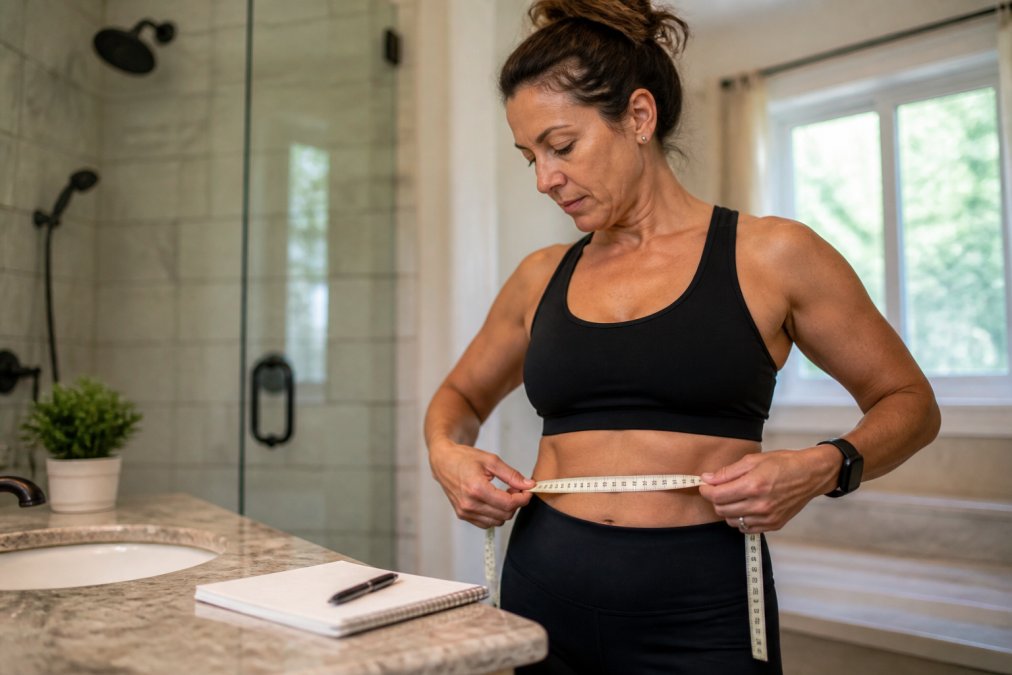
Here's a practical tracking method you can start this week:
Learn more about HER Aligned here →
| What to Track | How Often | What It Tells You |
|---|---|---|
| Waist measurement | Every 2 weeks | Fat loss around the abdomen |
| Progress photos | Every 4 weeks | Body composition changes |
| Strength numbers | Every session | Muscle retention |
| Energy and sleep | Daily, brief note | Recovery and sustainability |
| Scale weight | Optional, weekly | One data point, not the verdict |
A tape measure at the waist, same spot, first thing in the morning, gives you more useful information than daily weigh-ins. Strength numbers are the clearest signal that you're holding onto muscle while fat comes off. If your lifts hold or climb while your waist shrinks, you're doing it right.
Body fat percentage tools like DEXA scans and bioelectrical impedance can be useful reference points.
The Psychological Trap of Scale-Only Tracking
This is not a mindset trick you can think your way out of. It is a pattern that lives underneath your choices, and it needs the same specificity as your training and your protein intake. The women who keep their results are not the ones with the most willpower. They are the ones who stopped letting a noisy number decide whether they were allowed to keep going.
What Actually Works for Sustainable Fat Loss
Sustainable fat loss rests on structure, not motivation. The women who keep their results for life aren't more disciplined than you. They've changed the patterns underneath their choices, so consistency stops depending on how they feel on any given Tuesday.
The work that lasts looks like this:
- Building awareness of your actual eating patterns, without judgment, before changing anything
- Identifying the specific thinking that drives the 9pm kitchen trip
- Practicing consistency as "most of the time" rather than perfect
- Rebuilding self-trust through small promises you actually keep
- Training strength so your body has a reason to hold onto muscle
Frequently Asked Questions
Which one is better, fat loss or weight loss?
Fat loss is the better goal for perimenopausal women because it preserves lean muscle mass while reducing adipose tissue. Weight loss can include muscle loss, which slows metabolic rate and makes it harder to keep results. Research shows that resistance training combined with a modest caloric deficit helps maintain muscle while losing fat. The scale may move slower with fat loss, but body composition improves.
How do I tell if I'm losing weight or fat?
Track body measurements, how clothes fit, and progress photos alongside the scale. A DEXA scan or bioelectrical impedance can estimate body fat percentage, but these vary in accuracy. If your waist measurement drops while scale weight stays stable, you are likely losing fat and retaining muscle. Non-scale victories like improved energy and strength also signal fat loss.
Can I lose fat without losing weight?
Yes. Fat loss without scale movement happens when you gain lean muscle while losing adipose tissue. This is common for women over 40 doing resistance training. The scale may stay the same because muscle is denser than fat. Focus on body composition changes, how your clothes fit, and energy levels rather than scale weight alone.
Why does the scale stay the same even when my clothes fit differently?
Water retention, glycogen stores, and hormonal fluctuations can mask fat loss on the scale. Perimenopause brings unpredictable oestrogen shifts that affect water balance. If your clothes fit better but the scale is static, you are likely experiencing body recomposition. Use waist measurements and progress photos to confirm fat loss without relying on scale weight.