 ultimate-guide
Benefits of Building Muscle After 40 for Women
Table of Contents
- Why Muscle Loss Accelerates After 40 (And Why It Matters More Than the Scale)
- The Benefits of Building Muscle After 40 for Women: Energy, Bones, and Body Composition
- Strength Training for Perimenopause: Why It Beats Cardio for Midlife Women
- How Long to See Muscle Growth After 40 (And What Slows It Down)
- Signs of Muscle Gain in Women: What to Look For Beyond the Mirror
- Recovery Protocols for Women Over 40: The Missing Piece in Most Training Plans
- Equipment-Free Home Modifications for Building Muscle After 40
- Frequently Asked Questions
Last Updated: September 20, 2026
Why Muscle Loss Accelerates After 40 (And Why It Matters More Than the Scale)
You're doing everything you've always done, and your body is responding differently. That's not in your head. Muscle loss after 40 is real, and it's driven by the drop in oestrogen that arrives with perimenopause, not by you suddenly getting lazy.
Muscle is your body's most metabolically active tissue, and when you lose it, the scale can stay exactly the same while your body composition quietly shifts. Fat takes its place.
The Benefits of Building Muscle After 40 for Women: Energy, Bones, and Body Composition
The benefits of building muscle after 40 for women go far beyond how you look. Muscle is your body's engine, your skeleton's shock absorber, and your metabolic reserve all at once. When you build it, you change how your body ages.
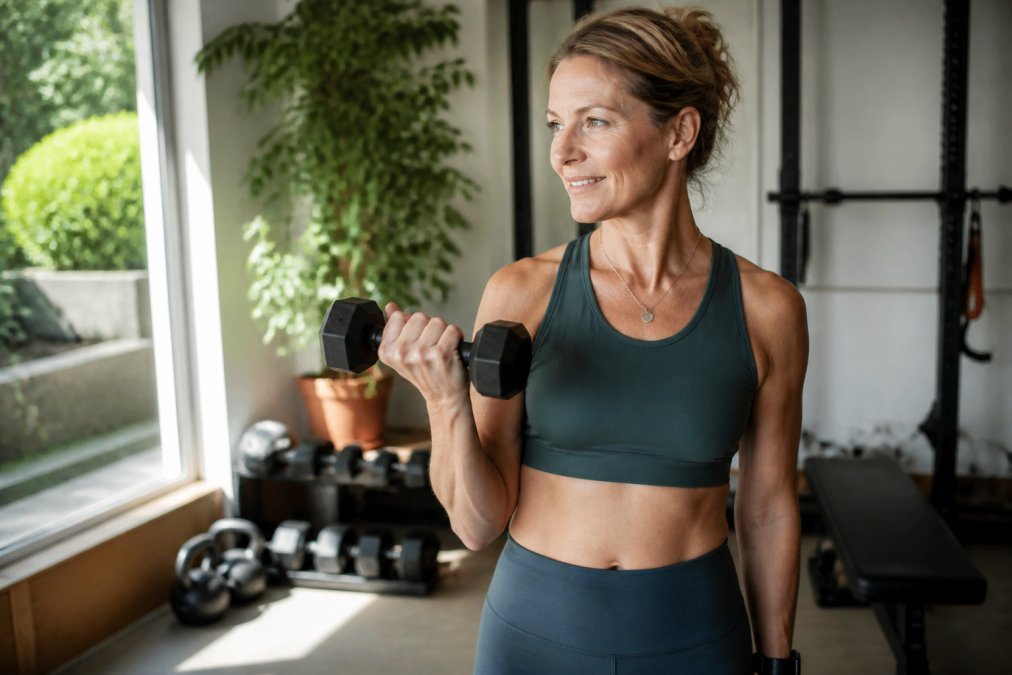
How Muscle Mass Influences Energy Levels During Perimenopause
Energy is the benefit women notice first, and it's the one they're least expecting. Muscle tissue is metabolically expensive, which means your body has to work harder to maintain it, and that translates into more usable energy through the day.
Strength Training and Bone Density in the Decade After 40
Bone density drops sharply as oestrogen falls, and resistance training is one of the few things that reverses that trend. Weight-bearing exercise places stress on bone, and bone responds by rebuilding itself stronger. This is how you protect against osteoporosis decades before it would otherwise show up.
Strength Training for Perimenopause: Why It Beats Cardio for Midlife Women
Strength training for perimenopause outperforms cardio for body composition, bone density, and insulin sensitivity. Cardio is good for your heart, and you should keep doing it, but it does not build or maintain muscle the way resistance training does.
Learn more about HER Aligned here →
| Goal | Best Approach | Why |
|---|---|---|
| Fat loss | Strength training + modest calorie deficit | Preserves muscle while you lose fat |
| Bone density | Heavy resistance, weight-bearing exercise | Load signals bone to rebuild |
| Energy | 3-4 strength sessions per week | Raises resting metabolic rate |
| Heart health | Cardio 2-3 times per week | Complements, doesn't replace, lifting |
How Long to See Muscle Growth After 40 (And What Slows It Down)
Most women notice strength gains in 4-6 weeks and visible muscle changes in 8-12 weeks. How long to see muscle growth after 40 depends far less on your age than on your consistency, your protein intake, and how hard you're actually training.
What slows it down:
- Training that never gets harder
- Under-eating protein
- Poor sleep and recovery
- Skipping sessions when life gets messy
- All-or-nothing thinking that turns one missed workout into three weeks off
Signs of Muscle Gain in Women: What to Look For Beyond the Mirror
The scale is the worst measure of muscle gain, and it's usually the only one women check. Signs of muscle gain in women show up in how you feel and function long before they show up in a mirror.
Look for these instead:
- Stairs feel easier and you're not winded at the top
- You can carry all the grocery bags in one trip
- Your posture changes without you thinking about it
- Clothes fit differently even when the scale hasn't moved
- You recover faster between sessions
Recovery Protocols for Women Over 40: The Missing Piece in Most Training Plans
What actually moves the needle:
Learn more about HER Aligned here →
- Sleep is the single biggest lever. Seven to nine hours, and the hours before midnight carry more repair value than the same hours after. If you are waking at 3am, that is a perimenopause sleep pattern, not a training problem, and it needs addressing on its own.
- Protein spread across the day, not saved for dinner. Most women over 40 who train consistently still under-eat protein at breakfast and lunch, which means the repair signal is weakest when the body is most primed to use it.
- Spacing. Forty-eight hours between sessions that hit the same muscle group is the default. If you are sore for three days, you either went too hard or your recovery is behind, and adding another session will not fix it.
- Walking on rest days. Not as cardio, as circulation. Twenty to thirty minutes moves blood through sore tissue and speeds the clearance of waste products.
- Stress load. This is not about lowering cortisol. The idea that cortisol is causing your belly fat in perimenopause is a myth that has been repeated so often it has become folklore. The real driver of midlife fat redistribution is the drop in oestrogen. What stress does is compete for the same recovery resources your muscles need. A high-stress week is a week your body is repairing less, no matter how well you eat.
The pattern I see most often in the women I coach is not under-training. It is under-recovering while training hard, then blaming themselves when the results stall. That is a structure problem, not a discipline problem, and it is exactly the kind of thing that gets missed when you are trying to piece a plan together from free articles. This is the gap the HER Aligned Coaching Membership is built to close, with training, recovery, and nutrition structured around where you actually are in perimenopause, and if you want to know which of those levers is currently working against you, the Free Peri Protocol is the place to start.
Equipment-Free Home Modifications for Building Muscle After 40
- Leverage. The further your centre of mass is from the working joint, the harder the movement. A push-up with hands under your shoulders is easy. Walk your hands forward six inches and the same push-up becomes a different exercise. That is leverage, and it is free.
- Tempo. Slow the lowering phase to four seconds on a squat or a push-up and you have increased the time under tension without changing the movement. Most women rush the lowering phase and wonder why nothing changes.
- Range of motion. A squat to a chair is a partial squat. A squat below the chair is a full one. Deeper range means more muscle worked per rep.
- Unilateral work. A single-leg sit-to-stand from a dining chair loads one leg with your entire bodyweight. Two sets of eight per side is a legitimate strength stimulus, not a warm-up.
- Pauses. Hold the hardest point of a movement for two seconds. The bottom of a push-up. The bottom of a squat. The top of a glute bridge. The pause removes momentum and forces the muscle to do the work.
- Loaded carries. A full laundry basket walked up and down the stairs is a farmer's carry. A gallon of water in each hand is a deadlift variation. Household tasks are training if you treat them as training.
- Chair sit-to-stands, slow tempo, three sets of ten.
- Incline push-ups against a sofa or wall, three sets of eight, hands progressively lower as you get stronger.
- Single-leg glute bridges, three sets of eight per side.
- Doorway rows using a towel and a closed door, three sets of ten.
- A loaded carry up and down the hallway to finish.
When you are ready to add resistance, a single pair of adjustable dumbbells and one long resistance band will carry you for years. You do not need a rack, a bench, or a monthly membership. You need a plan that progresses, and that is the part most home-training advice leaves out. Knowing which movement to progress, by how much, and when is where women get stuck, and it is exactly the kind of structure that turns twenty minutes on a living room floor into visible change.
Frequently Asked Questions
How long does it take to build muscle after 40 female?
Most women notice strength gains within 4 to 6 weeks of consistent resistance training. Visible muscle changes typically appear around 8 to 12 weeks. The rate depends on your training history, protein intake, sleep quality, and how well you recover between sessions. Menopause status also plays a role because oestrogen affects muscle repair. The key is progressive overload: gradually increasing weight or reps over time, not just showing up.
Is it harder to build muscle after 40?
The training principles for building muscle are the same in your 40s as in your 30s. What changes is recovery capacity and hormonal fluctuations during perimenopause, which can affect how quickly you bounce back between sessions. You do not need a different programme, but you do need to prioritise sleep, protein, and adequate rest days. Muscle hypertrophy responds to the same stimulus: progressive overload and consistency.
What are some signs that a woman is gaining muscle?
Early signs of muscle gain in women include lifting heavier weights than you could a month ago, feeling more stable on stairs or uneven ground, and noticing your clothes fit differently even if the scale has not moved. You may also see more definition in your arms or legs. Energy levels often improve before visible changes appear. Progress photos and strength logs reveal more than the scale.
How often should a woman in her 40s lift weights?
Two to three full-body resistance sessions per week is enough to build and maintain muscle. Each session should include compound movements like squats, hinges, pushes, and pulls. Recovery matters as much as the training itself, so avoid back-to-back heavy sessions. If you are new to lifting, start with two sessions and add a third once your recovery feels solid.