 how-to
Building Self Trust: Create Results That Stick
Table of Contents
- Why Self-Trust Is the Missing Piece in Your Results
- How to Stop All or Nothing Thinking and Build Consistency
- The Accountability Loop: Making and Keeping Commitments to Yourself
- Recognising Self-Sabotage and Breaking the Cycle
- Building Self-Efficacy for Weight Management and Lasting Change
- The Physiological Feedback Loop: How Small Wins Rebuild Trust
- Recovering Self-Trust After Failure and Starting Again
- Aligning Your Actions with Your Values for Authentic Change
Last Updated: August 16, 2026
Why Self-Trust Is the Missing Piece in Your Results
You've lost weight before. You know how to eat well, you understand movement, and you're disciplined enough to follow a plan. Yet somehow you end up back where you started, cycling through another restart, another app, another promise that this time will be different.
The real problem isn't that you don't know what to do. It's that you haven't built self-trust, and without it, no amount of nutritional knowledge or training intensity will stick. The ones who break free aren't necessarily the ones with the best meal plan. They're the ones who rebuilt their relationship with themselves first, treating themselves like someone worth keeping promises to rather than a problem to be solved.
Over 12 years coaching women through perimenopause, I've worked with hundreds through this exact cycle. The pattern is always the same: self-trust is built through tiny, specific actions. It's what happens when you say you'll move your body three times this week and you actually do it, not because you're perfect, but because you follow through on your word to yourself. It's the feeling you get when you eat a biscuit without spiralling into an all-or-nothing collapse. It's knowing that if you miss a workout, you don't throw the entire week away.
Most weight loss attempts fail because they focus entirely on the external, the visible, the measurable. But the internal architecture, the beliefs you hold about your own reliability, the narrative you've built about whether you're someone who keeps promises to herself, these determine everything.
How to Stop All or Nothing Thinking and Build Consistency
All-or-nothing thinking is the belief system that keeps you trapped in cycles of starting over. One missed workout means you've "failed", one biscuit means you've "blown it", and once you've blown it, you might as well abandon the entire week.
The problem isn't willpower or discipline. It's how you've learned to interpret your own behaviour. You've defined consistency as perfection, which is an impossible standard. What actually builds results that stick is showing up imperfectly, repeatedly.
Consistency is not a straight line. It's a pattern of behaviour over time, with inevitable deviations built in. A woman who trains four times per week but misses one week per month is still consistent. A woman who eats well most days but has a few nights where she eats more is still someone with a healthy relationship with food.
The shift happens when you redefine consistency as "returning to your plan after deviation" rather than "never deviating". This is the actual skill. Not avoiding the biscuit, but eating the biscuit and still being able to move forward tomorrow without shame, without the mental spiral, without the restart narrative.
Here's what this looks like: you have a stressful day, you eat more than you intended, and instead of "I've ruined everything, I'm starting again on Monday", the conversation becomes "I was stressed and I coped with food. That's information. Tomorrow I'll do things differently". That's consistency. That's the behaviour pattern that builds self-trust.
One of the most specific shifts we see with clients is when they stop using the word "cheat" entirely. The language of cheating assumes there's a rule you're breaking, a moral dimension to food choices. There isn't. There's just food, and your body, and your choices in any given moment. Some choices move you toward your goals, some don't. Neither makes you good or bad.
| Thinking Pattern | What It Creates | The Shift Required |
|---|---|---|
| All-or-nothing | Restart cycles every week | Deviation is normal, returning is the skill |
| Perfection-based | Shame when you're human | Consistency is imperfect repetition |
| Rule-breaking | Moral judgement of food | Neutral observation of choices and outcomes |
The Accountability Loop: Making and Keeping Commitments to Yourself
Making commitments to yourself and actually keeping them is the core mechanism of self-trust. Not grand commitments, but small, specific, measurable ones you can actually deliver on.

The accountability loop works like this: you make a specific commitment (not "I'll exercise more", but "I'll do a 30-minute strength session on Tuesday at 6pm"), you follow through, and you acknowledge that you followed through. That acknowledgement is crucial. Most women skip this step entirely. They complete the action but never actually register it as evidence that they're someone who keeps promises.
Your brain is constantly collecting data about you. Every time you say you'll do something and you do it, that's a data point. Over months and years, these data points add up into a narrative about your reliability. If the narrative is "I'm someone who follows through", you build self-trust. If the narrative is "I always start strong but can't maintain it", you don't.
The specific practice is this: at the end of each week, write down three things you committed to and delivered on. You said you'd move your body three times and you did it three times, even if one session was shorter than planned. You said you'd track your food and you did, even if you didn't do it every single meal. These are the wins that rebuild the narrative.
This isn't about motivation or discipline. It's about evidence. You're building a body of evidence that proves to yourself that you're reliable.
When you don't follow through, get curious. You said you'd move your body three times and you only did it once. Why? Was the commitment unrealistic given your week? Did you hit a barrier you didn't anticipate? This information matters. It's not failure, it's data that helps you make better commitments next time.
Recognising Self-Sabotage and Breaking the Cycle
Self-sabotage is the pattern where you actively work against your own goals, often without realising you're doing it. It shows up as procrastination on meal prep, choosing to skip the workout you'd planned, reaching for food when you're not physically hungry. It's not laziness. It's a protective mechanism.
Self-sabotage happens because some part of you has learned that staying small, staying stuck, or staying in familiar patterns is safer than moving forward. Maybe you've watched weight loss attempts fail before, so on some level you expect this one to fail too, and sabotaging it gives you a sense of control. Maybe you're afraid that if you lose weight, you'll have to show up differently in your relationships or your career.
The pattern usually looks like this: you feel good about your progress, you're building momentum, and then something shifts. You have a difficult conversation, you feel stressed, you get tired, and suddenly the commitments that felt easy become impossible. This is self-sabotage in action, and it's almost always triggered by emotion, not by actual barriers.
Recognising it means paying attention to the moments just before you sabotage. What emotion precedes the action? Is it fear? Overwhelm? Resentment? Anxiety about what might change if you succeed? Once you know what emotion is driving the sabotage, you can work with it instead of just fighting the behaviour.
The way to break the cycle is to make the sabotage conscious. Instead of unconsciously reaching for food when you're stressed, you pause and say out loud: "I'm about to use food to cope with stress". Instead of finding reasons to skip the workout, you name it: "I'm scared of what might happen if I keep going, so I'm creating an escape route". Conscious choice is always more powerful than unconscious pattern.
Building Self-Efficacy for Weight Management and Lasting Change
Self-efficacy is the belief that you're capable of doing what's required to reach your goals. It's not "I'm a confident person". It's "I'm someone who can navigate a social event and make food choices that align with my goals" or "I'm capable of moving my body consistently even when I'm busy".
Self-efficacy for weight management is built through small, repeated successes in the specific contexts where you struggle most. If your barrier is emotional eating, self-efficacy is built by successfully navigating emotional moments without using food. If your barrier is consistency, self-efficacy is built by showing up repeatedly, even when motivation is low.
Research on behaviour change shows that self-efficacy is one of the strongest predictors of whether someone will maintain new behaviours. It's not about having the perfect plan. It's about believing that you're capable of executing whatever plan you have, and that belief is built through experience, not through positive thinking.
Break down your larger goal into smaller sub-goals that you can build efficacy around. Instead of "lose 20 pounds", the sub-goals might be: "I can make a food choice that serves my goal even when I'm stressed" or "I can move my body three times per week even when my schedule is full" or "I can enjoy social situations without using food as my primary coping mechanism". Each of these is a belief you build through repeated experience.
Learn more about HER Aligned here →
When working with me through the HER Aligned Coaching Membership, the entire structure is designed around building self-efficacy in the specific areas where you've struggled most. It's not a generic programme. It's customised to your barriers, your patterns, and the exact contexts where you need to build capability. That's why the approach works where other programmes don't. You're not trying to change everything. You're building competence in the areas that matter most to your results.
The Physiological Feedback Loop: How Small Wins Rebuild Trust
Your body has a feedback system that responds to your actions. Every time you move, eat in a way that serves your goals, sleep well, or manage stress effectively, your body sends signals back to your brain. These signals create a feedback loop that either reinforces the behaviour or undermines it.
When you make a commitment to yourself and follow through, your nervous system registers that as safety. You did what you said you'd do, which means the world is predictable and you're reliable. Your stress hormones decrease. Your sleep improves. Your energy stabilises. Your digestion works better. All of this happens because your nervous system has learned that you can trust yourself.
Conversely, when you make commitments and break them repeatedly, your nervous system learns that you're not reliable. This creates a low-level stress state where your body is constantly braced for disappointment. In this state, it's harder to make good food choices because your nervous system is in a protective, survival mode.
The small wins matter because they're what activate this feedback loop. You don't need to lose 20 pounds to feel the physiological shift. You need to follow through on moving your body three times, and feel how that changes your energy and mood. You need to navigate one stressful situation without using food to cope, and notice how that shifts your relationship with yourself. These small wins are what rebuild the loop.
Consistency matters more than intensity. A woman who does 20 minutes of movement three times per week, consistently, will see better results than a woman who does intense workouts sporadically. The consistency is what creates the feedback loop.
Recovering Self-Trust After Failure and Starting Again
You will fail. You'll have weeks where you don't follow through. You'll make commitments you don't keep. You'll have moments where you sabotage your own progress. This is not a character flaw. This is part of being human.
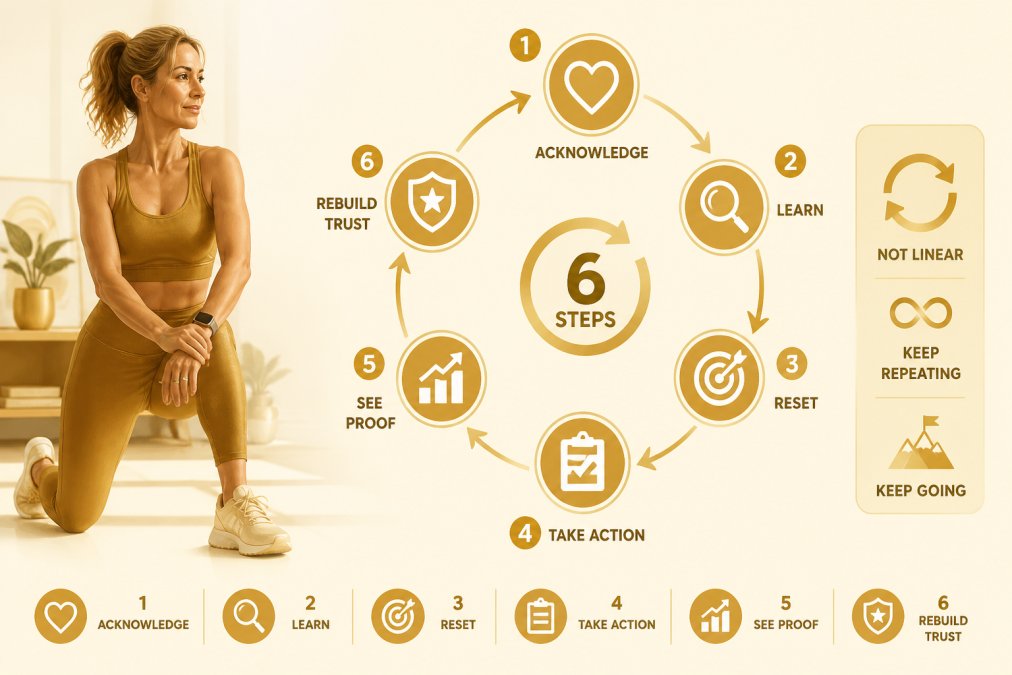
The question is not whether you'll fail. The question is what you do after you fail. This is where self-trust either gets rebuilt or gets destroyed further.
The pattern most women follow is this: they fail, they feel shame, they tell themselves they're not capable, and they give up. The failure becomes evidence that confirms the negative narrative they already hold about themselves.
Recovering self-trust after failure requires a specific process. First, you separate the failure from your identity. You didn't fail because you're a failure. You failed because you made a choice in a moment, or because a circumstance was harder than you anticipated, or because you hit an emotional barrier you didn't know how to navigate. The failure is data, not destiny.
Second, you get specific about what happened. Not "I failed at my diet" but "I made food choices that didn't serve my goals because I was stressed about work and I didn't have another coping mechanism ready". That specificity matters because it shows you exactly what to work on next time.
Third, you make a smaller commitment and follow through. You don't try to jump back to where you were before the failure. You make a commitment so small that you know you can deliver on it, and you deliver on it. You're rebuilding the evidence that you're reliable. One small win at a time.
The women who actually keep their results for life are not the ones who never fail. They're the ones who fail, recover quickly, and keep going. They've learned that failure is not the end of the story. It's a chapter. And they're the author of what comes next.
Aligning Your Actions with Your Values for Authentic Change
Values are the things that actually matter to you, not the things you think should matter. You might think you should value being thin, but what you actually value might be having energy to play with your kids, or feeling strong and capable in your body, or being able to wear clothes you love without self-consciousness. These are different, and they matter.
When your actions align with your actual values, change becomes sustainable because you're not forcing yourself to do things that feel meaningless. You're not white-knuckling through deprivation. You're building a life that reflects what actually matters to you.
The first step is getting clear on your actual values, not your should values. This requires brutal honesty. If you say you value health but what you actually value is comfort and ease, that's the value to work with. If you say you value confidence but what you actually value is being liked by others, that's what matters. This isn't about judgment. It's about accuracy.
Once you know your values, you align your commitments to them. If you value energy and vitality, your commitment isn't "I'll exercise because I should". It's "I'll move my body because I want to feel strong and energised throughout my day". That's a completely different internal experience. One feels like obligation. The other feels like choice.
This is where authentic change happens. Not through force, but through alignment. You're not fighting against yourself anymore. You're moving toward something that actually matters to you.
Building self-trust is the foundation that makes everything else possible. It's what transforms a temporary weight loss into lasting change. It's what allows you to recover quickly when you fail instead of spiralling into shame. It's what makes you someone who keeps promises to herself, and that changes everything.
If you're ready to stop the restart cycle and actually build the trust in yourself that creates results that stick, start with the Free Peri Protocol to get clear on exactly where your self-trust has broken down and what needs to be rebuilt. Then, if you're ready to work with me directly, apply for 1:1 coaching and let's build the self-trust that makes you unstoppable.
Frequently Asked Questions
What is the difference between self-trust and willpower?
Willpower is a temporary force you apply when you don't believe you can follow through. Self-trust is the internal certainty that you will do what you say, built through repeatedly keeping small commitments to yourself. Willpower depletes; self-trust compounds. When you have genuine self-trust, you don't need willpower because you've already proven to yourself that you keep your word.
How do I rebuild self-trust after I've failed at diets and programs before?
Start with commitments so small they feel almost silly. Not 'I'll never eat sugar again', but 'I'll drink water before my morning coffee for three days'. Keep that promise. Then build from there. Each kept commitment rewires your nervous system and creates the evidence your brain needs to believe you again. This is how you move from 'I always fail' to 'I follow through'.
How does building self-efficacy actually help me lose weight and keep it off?
Self-efficacy is your belief that you can succeed at specific tasks. When you build self-efficacy around nutrition awareness and strength training, you stop relying on external plans and start trusting your own decision-making. You recognise hunger cues, understand your patterns, and make choices aligned with your goals. This internal locus of control is what keeps the weight off when the program ends, because you're not following rules anymore, you're living in a way that reflects who you've become.
What should I do if I break a commitment to myself and feel like I've lost all progress?
One broken commitment is not a pattern. The difference between people who keep results and those who don't is how they respond to a slip. Instead of spiralling into all-or-nothing thinking ('I've failed, might as well give up'), you acknowledge it, understand what happened (stress, hunger, emotion?), and recommit the next day. Self-trust isn't about perfection. It's about your ability to get back on track when you slip.