 How-to
Strength Training for Women Over Forty: A Progressive Approach
Last Updated: November 17, 2026
Quick Summary
Strength training for women over forty works on the same principles it always has: a steady, progressive load builds muscle and bone, and the plan is what changes results. Training with a written rule for adding weight, two full-body sessions a week, and consistency beats perfection, and that approach is what breaks a plateau.
- Plateaus usually signal a missing progression, not a failing body
- Add load only when you complete all sets with two reps in reserve
- Start with two full-body sessions a week, spaced at least two days apart
- Track load, reps and completed sessions rather than body weight
- Use a deload of roughly 20 percent for one week when progress stalls twice
Table of Contents
- Why the Plateau Keeps Coming Back When You Train
- Why Women Over Forty Don't Need a Gentler Program
- Weight Training Over 40: The Female Benefits That Matter Most
- Strength Training for Women Over Forty at Home: Equipment and Substitutions
- A Beginner Progression You Can Actually Stick To
- Building a Strength Training Workout Plan for Women Over Forty
- Why Consistency Beats Perfection, and What to Do Next
- Frequently Asked Questions
Why the Plateau Keeps Coming Back When You Train
You've been lifting for months, maybe longer, and the scale has barely shifted. The weights feel heavier, your energy dips by mid-afternoon, and you're starting to wonder if your body has simply stopped responding. It hasn't. The problem is usually the program itself, and the way you've been approaching it.
Most women in perimenopause start strength training for women with one of two plans. Either they follow a generic beginner routine they found online, or they swing between intense bursts and long gaps when life gets busy. Our sustainable fat loss guide for perimenopausal women explains why the scale stops moving even when your training looks busy.
Here's the belief keeping you stuck: that you need to go easier because you're over forty. Strength training doesn't work that way. Your body still responds to the same principles it always has, which is why the next section matters.
- A plateau usually signals a missing progression, not a failing body
- Random effort produces random results
- Overly gentle programming rarely builds the strength you're after
Why Women Over Forty Don't Need a Gentler Program
Many women over forty are told to "take it easy," lift lighter, and stick to machines. That advice sounds sensible, but it quietly undercuts the outcome you want. Muscle adapts to load. If the load never climbs, the adaptation never comes.
The research on resistance training is consistent here. Meta-analyses of resistance exercise show that muscle protein synthesis responds to sufficiently challenging loads across many ages. The training principles are the same in your forties as they were in your thirties.
Weight Training Over 40: The Female Benefits That Matter Most
Resistance training gives you more than a stronger body. For women in perimenopause, it addresses the specific losses this stage brings.
- Muscle mass naturally declines with age, and resistance work is the most direct way to slow it
- Bone density responds to loading, which matters as oestrogen falls
- Lean muscle supports how your body handles blood sugar and daily energy
- Stronger muscles make everyday movement feel easier, which lifts confidence
Notice what's missing from that list: a magic fat-burning trick. For a deeper look at how this fits into your overall plan, see our benefits of building muscle after 40 for women and the case for resistance training for metabolic health.
Losing muscle during perimenopause is a real risk, and it's one you can meaningfully reduce. Our guide on preventing muscle loss during perimenopause walks through how training protects what you've built.
Strength Training for Women Over Forty at Home: Equipment and Substitutions
You don't need a full gym to start. A pair of adjustable dumbbells, a resistance band and a sturdy chair will cover most of what you need.
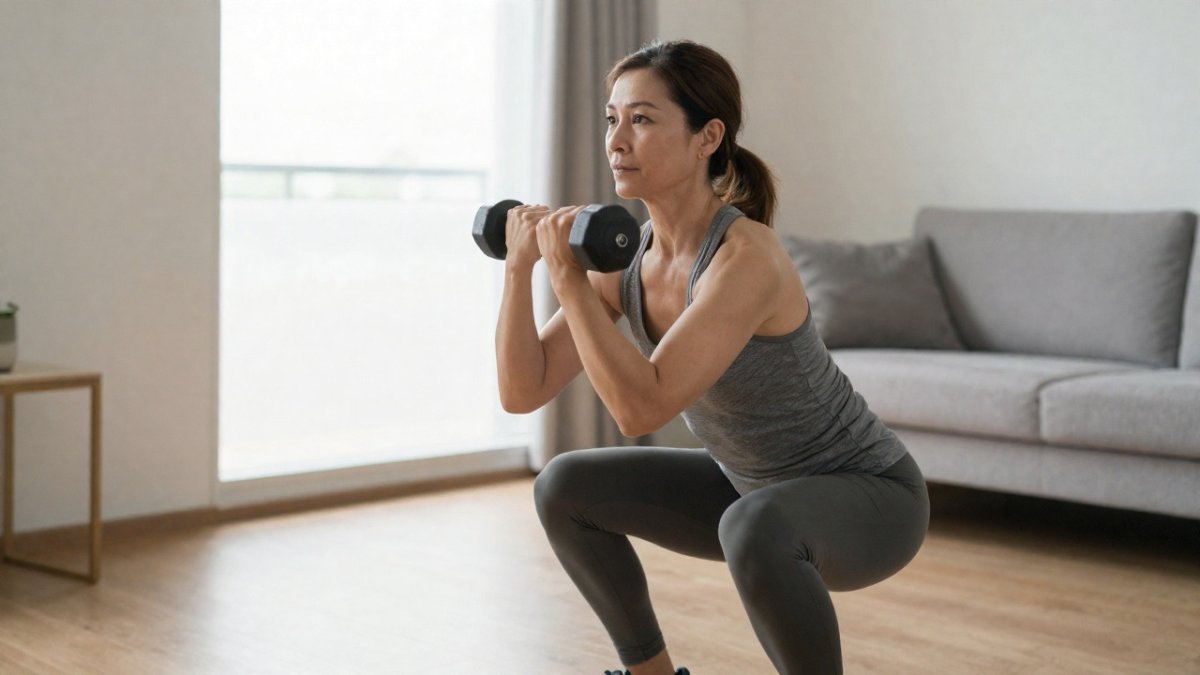
If you have a bad knee or a sore shoulder, substitute rather than skip. A box squat replaces a full squat when depth hurts. A glute bridge stands in for a hip thrust when you lack a bench.
Home training also makes consistency easier, which is where most women struggle. Keep the equipment visible, schedule sessions like appointments, and track the weight you use each week.
A Beginner Progression You Can Actually Stick To
Progression is what separates a plan that works from one you abandon by week three. The women who stall are rarely lazy.
Start with two full-body sessions a week, spaced at least two days apart, using five movement patterns per session: a squat, a hinge, a push, a pull, and a carry or core movement. Two sessions is the floor, not a compromise. It is enough to build strength and few enough that a messy week does not wipe out your training.
Here is a four-week structure for beginners. It is deliberately unglamorous, because the first month is where the habit and the technique get built.
Week 1: find your working weight. For each exercise, pick a weight you can lift for eight reps with two or three reps still in the tank, meaning you could have done two or three more with clean form. Write down the weight and the reps for every set. This week is calibration, not training to failure.
Week 2: repeat the same weights. Same exercises, same loads, aim for one more rep per set than week 1.
Week 3: add load to the main lifts. Add the smallest increment your equipment allows, typically 2.5 to 5 pounds on dumbbells or one plate on a machine, to the squat and hinge patterns only. Keep the push, pull, and carry at week 2 loads. Drop back to the bottom of your rep range and build again.
Week 4: consolidate. Hold week 3 loads and push reps back up. If every set feels controlled and you finish with two reps in reserve, week 5 starts a new cycle with small increases across all five patterns.
The advancement rule is the part most women skip: add load only when you complete all prescribed sets and reps with two reps in reserve and no form breakdown. If your last rep turns into a wobble, a shrug, or a rounded back, you did not earn the increase. Hold the weight another week.
Watch out: the most common beginner error is adding weight every single session because it feels productive. Tracking each increase keeps progression deliberate, whether you are lifting in a gym or practicing beginner strength training at home.
Choosing Weights, Sets and Rest Days
Choose a weight that makes the last two reps of each set feel hard but controlled. Aim for two to three working sets per exercise, with 60 to 90 seconds of rest between them. Rest days matter as much as training days, since muscle rebuilds between sessions rather than during them.
The progression comes down to a short sequence of weeks, each with a clear job, so you always know what to do next.
| Week | Focus | What to do |
|---|---|---|
| 1 | Find your working weight | Pick a weight for eight reps with two or three in reserve |
| 2 | Repeat the same weights | Aim for one more rep per set than week 1 |
| 3 | Add load to main lifts | Increase squat and hinge by the smallest increment |
| 4 | Consolidate | Hold week 3 loads and push reps back up |
| 5+ | New cycle | Add small increases across all five patterns |
Building a Strength Training Workout Plan for Women Over Forty
Here is a weekly structure you can run for eight weeks before changing anything. If you want to know which movements matter most for this stage, read our best strength training exercises for perimenopause. Two sessions, alternated across the week, with at least one rest day between them. Monday and Thursday, or Tuesday and Saturday, both work. The schedule matters less than the gap between sessions.
Session A opens with a goblet squat, three sets of eight to ten reps. Next, a dumbbell row, three sets of eight to ten per side. Then a glute bridge, three sets of ten to twelve. Finish with an overhead press, three sets of eight to ten, and a farmer's carry, three walks of 30 to 40 seconds.
Session B opens with a Romanian deadlift, three sets of eight to ten. Next, an incline push-up, three sets of six to ten. Then a split squat or reverse lunge, three sets of eight per leg. Finish with a band or cable row, three sets of ten to twelve, and a dead bug, three sets of eight per side.
Each week, apply the progression rule from the previous section: add one rep or a small load increase to the main movements when you have earned it.
Substitutions for home, gym, and limited equipment. Every movement has a swap that keeps the pattern intact.
Technique cues that prevent the common errors. For the goblet squat, brace as if you are about to be poked in the stomach, sit between your hips rather than folding forward, and keep your whole foot planted.
How to measure progress beyond the scale. Body weight is the least useful number in the first three months of strength training, because you can gain muscle and lose fat at the same time and see the scale sit still. Track five things instead: the load and reps on your main lifts, the number of sessions you completed out of the scheduled number, how many push-ups or step-ups you can do in a minute, whether carrying groceries or climbing stairs feels easier, and how recovered you feel the day after training. A woman who adds 10 pounds to her goblet squat, completes seven of eight scheduled sessions, and stops waking up stiff is making progress the scale cannot see.
Watch out: do not change the program every two weeks because you saw a new routine online. Eight weeks of the same structure with small load increases beats eight different programs run for a week each. The variable that drives results is the progression, not the novelty.
You'll notice this plan asks for discipline, not perfection. Miss a session, and the next one still counts.
Why Consistency Beats Perfection, and What to Do Next
The women who keep their results are rarely the ones with the flawless program. They're the ones who train through a messy week, adjust without quitting, and stop treating a missed session as proof they've failed.
With 12+ years of experience coaching women through perimenopause, Coach Justine helps clients build the self-trust that makes consistent training possible, alongside the strength work itself.
If you're ready for more structure than a free plan can give you, start with the free Peri Protocol assessment to see where your current training is holding you back. When you want support week to week, the HER Aligned Coaching Membership gives you a clear plan, accountability and the coaching to stay with it.
Frequently Asked Questions
How often should women over forty strength train?
Most women over forty do well with two to three full-body strength sessions per week, with at least one rest day between sessions that work the same muscle groups. Consistency across weeks matters more than the number of sessions in any single week. Starting at two sessions and building up once the movements feel familiar tends to hold up better than starting at four and burning out by week three. Track whether you are completing your planned sessions, because that is usually the real limiting factor.
Can women over forty build muscle with strength training?
Yes. The training principles that build muscle in your thirties, including progressive overload, adequate effort and sufficient protein intake, apply equally in your forties and beyond. Research on resistance training shows meaningful gains in muscle size and strength across adult age groups when the programme is progressive. The difference is usually recovery and consistency rather than the method itself, so plan your sleep and rest days as seriously as your sets.
Can I start strength training at home after forty?
Yes. Bodyweight movements, resistance bands and a single pair of adjustable dumbbells cover the major movement patterns: squatting, hinging, pressing, pulling and carrying. Home training works best when you can make each exercise progressively harder, for example by slowing the lowering phase, adding a pause or moving to a heavier band. Set up a dedicated space and schedule sessions in your calendar, as the biggest home-training barrier is usually friction rather than equipment.
What is a good strength training routine for a beginner over forty?
A good beginner routine is full-body, uses two to three sessions per week and focuses on five to six foundational movements: a squat pattern, a hinge, a push, a pull, a carry and a core exercise. Start with two sets of eight to twelve repetitions using a weight you could lift for a few more reps, and add load or repetitions over several weeks. Technique matters more than load in the first month, so film a set or check your form against a coach before increasing weight.