 blog
blog
Healthy Snacks for Busy Women on the Go
Table of Contents
- Why Snacking Falls Apart When You're Busy
- The Real Problem With Food Noise and Constant Hunger
- High-Protein Snacks for Perimenopause Energy Crashes
- Portable, Non-Perishable Options That Actually Satisfy
- Shelf-Stable Pantry Staples You Can Grab Without Thinking
- Building a Snack Strategy That Fits Your Schedule
- When Snacking Becomes Avoidance
- Frequently Asked Questions
Last Updated: September 30, 2026
Why Snacking Falls Apart When You're Busy
Finding healthy snacks for busy women on the go isn't about willpower; it's about building a system that works with your actual life. You're snacking poorly because the moment you get busy, your snacking strategy collapses. You grab whatever's closest, fastest, and requires zero thinking. That's not a character flaw. That's what happens when you haven't built a system that works with your actual life, not against it.
Most women tell me the same thing: "I know what I should eat. I just don't have time to prepare it." But here's what I've learned after 12 years coaching busy perimenopausal women through this exact problem. The issue isn't knowledge. It's that you're trying to maintain a snacking strategy that depends on decisions you won't have time to make when you're in the middle of your day.
Healthy snacks for busy women on the go aren't about finding the perfect food. They're about removing the decision-making moment entirely. That's the difference between a snacking strategy that works and one that fails.
The Real Problem With Food Noise and Constant Hunger
Food noise is the constant mental chatter about what you're eating, what you should eat, whether you're eating the right thing. It's exhausting. And in perimenopause, when your oestrogen drops, your hunger hormones become less stable. That means your body is actually sending you stronger hunger signals, and your brain is simultaneously running commentary on all of it.
The result? You're not just hungry. You're hungry and distracted by hunger simultaneously.
This is where most snacking advice fails you. Generic guides tell you to "reach for protein and fibre." True enough. But they don't account for the fact that you need snacks that are so straightforward you don't have to think about them. No decision fatigue. No debate about whether this counts as "healthy enough."
When a snack requires you to assess it, prepare it, or justify it to yourself, you've already lost. You'll skip it or replace it with something that doesn't require that mental load.
High-Protein Snacks for Perimenopause Energy Crashes
Energy crashes in perimenopause aren't random, and they're not something you can willpower through. They happen because oestrogen regulates how your body manages glucose. When oestrogen declines, your cells become less sensitive to insulin, which means your blood sugar swings more dramatically. You eat lunch at noon, feel fine at 1 p.m., and by 3 p.m. you're exhausted and hunting for carbohydrates. That's not weakness. That's your physiology changing.
This is where the snacks that worked for you in your 30s genuinely stop working. A banana and a handful of almonds might have steadied you then. Now the same snack leaves you hungry an hour later because your body processes it differently.
Protein slows gastric emptying, which means food moves through your stomach more slowly (Effects of a Protein Preload on Gastric Emptying, Glycemia, and Gut Hormones After a...). This flattens the blood sugar curve. Instead of a sharp spike followed by a crash, you get a gentler rise and a slower decline. The result is that you stay satisfied longer and your energy doesn't plummet. Fat does this too, which is why protein-plus-fat combinations work better than protein alone.
Learn more about HER Aligned here →
The catch is this: the snack has to be something you'll actually eat when you're exhausted and have three things happening at once. A protein powder you have to mix doesn't count. A bar you bought three weeks ago and forgot about doesn't count. It has to be there, ready, and genuinely appealing to you in that moment.
Practical options that work:
- Hard-boiled eggs (buy them pre-made from the supermarket, keep them in your fridge, grab two when you feel the crash coming). Two eggs give you 12 grams of protein and about 10 grams of fat.
- String cheese or cheese cubes (grab and go, no prep, no decision required). One stick is roughly 7 grams of protein.
- Tinned fish with whole grain crackers (open tin, eat, done). A tin of sardines or mackerel has 20+ grams of protein and omega-3 fats that support stable energy.
- Greek yoghurt with a handful of nuts (mix it the night before if time is tight). Half a cup of Greek yoghurt has 10 grams of protein; a small handful of almonds adds another 6 grams plus fat for satiety.
- Protein-based leftovers from dinner (roasted chicken, grilled tofu, cooked lentils). This is the most underused option. If you cooked dinner, you have snacks for tomorrow already made.
The common mistake is buying expensive protein bars that taste like cardboard, then not eating them because they're not satisfying. Or buying protein powder and telling yourself you'll mix it when you're tired (you won't). Spend your money on real food you'll actually consume. A dozen eggs cost less than a box of protein bars and they work better.
The other mistake is pairing protein with nothing else. Protein alone doesn't give you the satisfaction signal your brain needs. Protein plus something with texture or taste (nuts, cheese, crackers, fruit) works because you get both satiety and satisfaction.
Portable, Non-Perishable Options That Actually Satisfy
Portable snacks are only useful if they actually satisfy you. A handful of rice cakes isn't portable. It's just depressing. And a snack that leaves you hungry 30 minutes later defeats the entire purpose of having it with you.
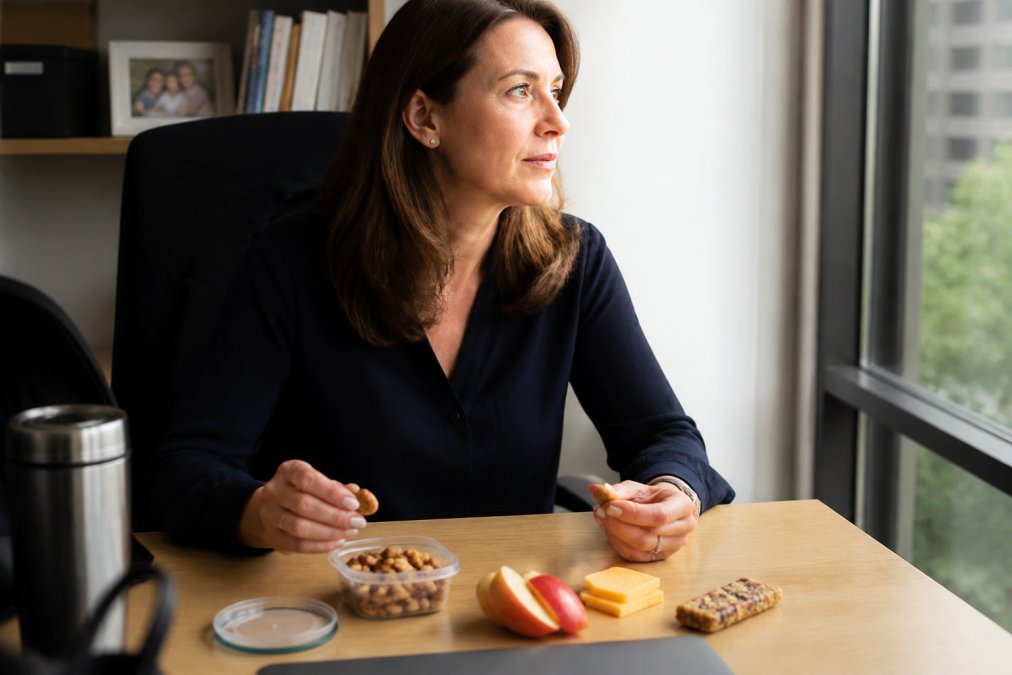
The principle that works is this: pair something with substance (protein or healthy fat) with something that gives you satisfaction (texture, taste, or volume). Nuts alone work. Crackers alone don't. Nuts plus crackers work because you get both satiety and the eating experience your brain is looking for.
Non-perishable snacks that work:
- Mixed nuts and seeds (almonds, walnuts, pumpkin seeds, sunflower seeds). A small handful (about 30 grams) gives you roughly 6 grams of protein and healthy fats that keep you satisfied for hours. Buy them in bulk and portion them into small containers or bags once a week.
- Whole grain crackers with individual cheese portions or nut butter packets. The crackers give you volume and texture; the cheese or nut butter gives you fat and protein. This combination is more satisfying than either alone.
- Dried fruit paired with nuts (dates with almonds, figs with walnuts, apricots with cashews). The dried fruit provides quick carbohydrates and natural sweetness; the nuts provide fat and protein to slow digestion. This pairing works because it addresses both immediate energy and sustained satiety.
- Protein-rich granola or oat bars (read the label, aim for 8 or more grams of protein per bar). Most commercial granola bars are high in sugar and low in protein, which means they taste good but don't keep you satisfied. Look for bars where protein is listed in the top three ingredients.
- Roasted chickpeas or edamame (shelf-stable versions exist in the snack aisle). These are higher in protein than most nuts (about 12 grams per serving) and give you a satisfying crunch.
The logistics matter more than the snacks themselves. Keep these in your desk drawer, your car, your bag, your locker at the gym. The moment you need a snack, it's there. No decision required. No trip to the vending machine or the café because you didn't plan ahead.
Here's where most busy women fail: they buy these snacks, bring them home, and then forget about them because they're not visible. If the snack is in your bag, you'll eat it. If it's in a cupboard at home, you won't. Store them where you'll actually use them, not where they're convenient to store.
Bulk prepping saves both money and time. If you're going to portion nuts, portion a week's worth at once. If you're going to buy mixed nuts, buy the largest container available and divide it into small portions on Sunday. This removes the decision-making moment during the week and means you're not paying premium prices for pre-portioned snacks.
Learn more about HER Aligned here →
Shelf-Stable Pantry Staples You Can Grab Without Thinking
Your pantry should contain snacks you can grab without opening your fridge or thinking about combinations. These are your emergency options when you're between meals and genuinely hungry.
Stock these:
- Nut butters (almond, peanut, tahini) in single-serving packets or jars
- Whole grain bread or crackers
- Tinned beans (black beans, chickpeas, white beans)
- Tinned fish (sardines, mackerel, tuna)
- Nuts and seeds in bulk
- Oats (steel-cut or rolled)
- Dark chocolate (70% cocoa or higher)
Building a Snack Strategy That Fits Your Schedule
Here's the framework:
Identify your actual snacking times. Not the times you think you should snack. The times you actually get hungry. For most busy women, this is mid-morning, mid-afternoon, or both. Write down when you're genuinely hungry.
When Snacking Becomes Avoidance
Here's where it gets honest: sometimes the snacking problem isn't actually about snacks.
Frequently Asked Questions
What causes constant hunger and food noise in perimenopause?
The drop in oestrogen during perimenopause shifts how your brain regulates appetite signals. You're not hungry because you lack willpower; your body is sending stronger hunger cues and taking longer to register fullness. High-protein snacks that stabilise blood sugar help your nervous system settle, but understanding this shift is the first step to stopping the mental chatter about food.
How do high-protein snacks for perimenopause help with fatigue?
Protein slows digestion and keeps blood sugar stable, preventing the energy crashes that trigger both physical fatigue and the urge to snack. When you pair protein with fibre (like almonds with an apple), you maintain steady energy for 3-4 hours instead of spiking and crashing. This consistency is what stops the constant reaching for food when you're actually tired, not hungry.
How do I know if I'm eating because I'm stressed versus actually hungry?
Physical hunger builds gradually and is satisfied by any food. Emotional hunger hits suddenly, craves specific foods, and leaves you feeling unsatisfied no matter what you eat. When you're busy, stress eating often masks itself as snacking 'because I haven't eaten.' Pausing to notice where the urge comes from (stomach growl versus scrolling anxiety) is the awareness that stops the cycle.
Can I actually stop snacking mindlessly without willpower?
Yes, but not by restricting yourself further. Mindless snacking persists because something underneath it is unmet: blood sugar crashes, emotional avoidance, or genuine hunger your meals aren't addressing. Once you stabilise your blood sugar with protein-rich meals and snacks, and you notice what you're actually avoiding when you reach for food, the mindlessness stops naturally. This is why structure and awareness matter more than discipline.