 blog
blog
Best Strength Training Exercises for Perimenopause
Table of Contents
- Why Strength Training Matters More Now Than Ever
- What the Research Actually Shows About Muscle and Bone
- The 10 Best Strength Training Exercises for Perimenopause
- Your Perimenopause Workout for Beginners: Where to Start
- How Often to Lift Weights During Perimenopause
- The Best Weights for Menopause Strength Training
- Common Mistakes That Keep Women Stuck
- Conclusion: Building a Body That Lasts
- Frequently Asked Questions
Last Updated: October 6, 2026
Why Strength Training Matters More Now Than Ever
If you're doing everything you did five years ago and your body has stopped responding, you're not imagining it. The best strength training exercises for perimenopause are the ones that protect the muscle and bone you're quietly losing.
Oestrogen is a major player in bone and muscle maintenance. As it drops, so does your ability to hold onto both. This guide covers the ten movements that do the most work for the least time, plus how to fit them into a real week.
National Institute on Aging on exercise and bone health
What the Research Actually Shows About Muscle and Bone
Strength training during perimenopause builds and maintains muscle mass, supports bone density, and helps with the everyday tasks that get harder when you stop lifting.
Much of the strong data on resistance training, bone density, and healthy ageing comes from broader adult populations rather than perimenopause-specific trials.
What the research doesn't support is the idea that your 40s need a different set of training rules.
The 10 Best Strength Training Exercises for Perimenopause
These ten moves cover lower body, upper body, and core without a commercial gym.
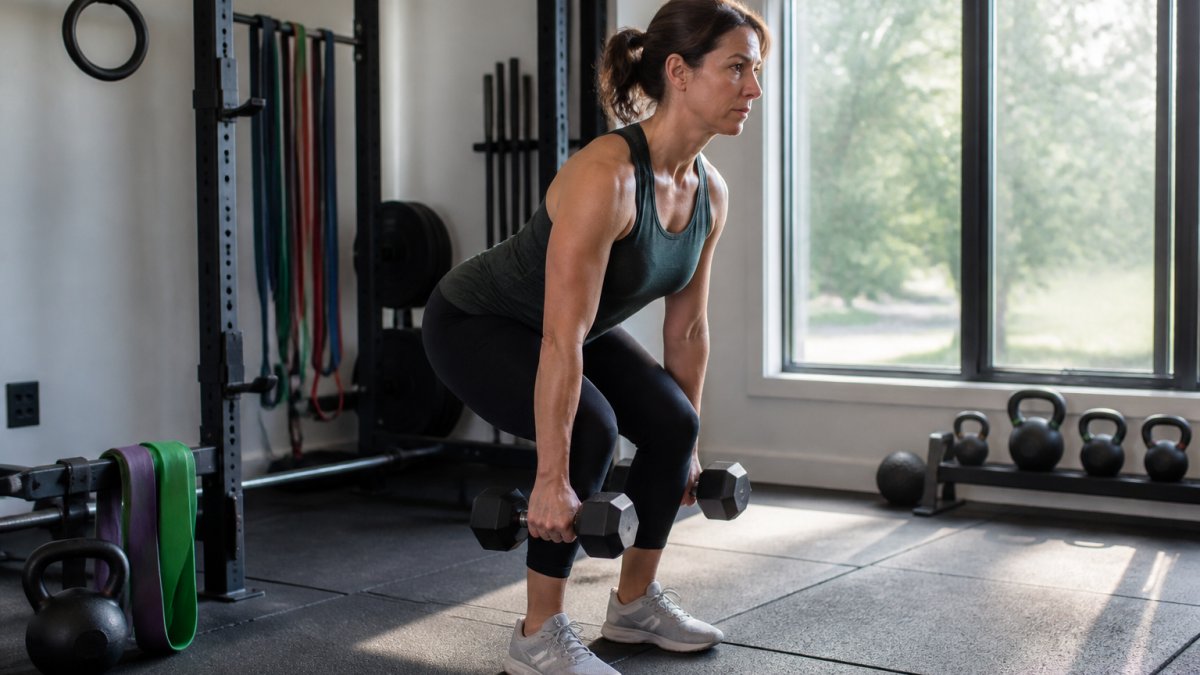
Do them in the order below, or split them across two sessions.
Lower Body: Squats, Deadlifts, and Lunges
- Goblet or back squat - 3 sets of 8-10 reps. Rest 90 seconds. Hold a dumbbell at your chest or a barbell across your upper back. Sit back and down, knees tracking over toes. Cue: brace your midsection as if you are about to be poked in the stomach, then descend. Common mistake: letting the knees cave inward as you stand. Regression: box squat to a sturdy chair, tapping and standing without sitting down fully.
- Hip hinge / deadlift - 3 sets of 8 reps. Rest 90 seconds. Push your hips back, keep your back flat, and drive through your heels to stand. Cue: imagine closing a car door with your backside, not bending at the waist. Common mistake: rounding the lower back at the bottom because the weight is too heavy to control. Regression: Romanian deadlift with just the bar or a pair of light dumbbells, focusing on the hinge pattern before adding load.
- Reverse lunge - 3 sets of 8 per leg. Rest 60 seconds. Step back, drop the back knee toward the floor, and push through the front foot to return. Cue: keep 70 percent of your weight in the front foot, not split evenly. Common mistake: stepping too short, which pushes the front knee past the toes and shifts load to the joint rather than the muscle. Regression: split squat with the back foot on the floor and hands on a chair for balance.
Upper Body: Push-Ups, Overhead Press, and Rows
- Push-up - 3 sets of 6-10 reps. Rest 60 seconds. On your toes or knees, keep your body in one line and lower your chest to the floor. Cue: screw your hands into the floor as if turning two jar lids outward, which stabilises the shoulders. Common mistake: letting the hips sag so the lower back takes the load. Regression: hands on a kitchen counter or a bench, which reduces the percentage of bodyweight you press.
- Overhead press - 3 sets of 8-10 reps. Rest 60 seconds. Press dumbbells from shoulder height to straight overhead without arching your lower back. Cue: squeeze your glutes and brace your abs before the first rep, so the press comes from the shoulders rather than the spine. Common mistake: pushing the head forward to clear the dumbbells instead of moving them slightly back. Regression: seated press with back support, or single-arm press with the other hand free to spot.
- Single-arm row - 3 sets of 10 per side. Rest 60 seconds. Support one hand on a bench, pull the dumbbell to your hip, and squeeze your shoulder blade. Cue: think about putting your shoulder blade in your back pocket at the top of the rep. Common mistake: rotating the torso to help the weight up, which turns a back exercise into a biceps exercise. Regression: chest-supported row lying face down on an incline bench, which removes the temptation to twist.
Core and Carries: Planks, Dead Bugs, and Suitcase Carries
- Plank - 3 holds of 20-40 seconds. Rest 45 seconds. Keep hips level and squeeze your glutes. Cue: tuck your ribs down toward your hips so the lower back does not arch. Common mistake: holding your breath, which spikes effort and shortens the hold. Regression: plank from the knees, or an incline plank with hands on a bench.
- Dead bug - 3 sets of 8 per side. Rest 45 seconds. Lie on your back, extend the opposite arm and leg, and keep your lower back pressed down. Cue: imagine balancing a cup of water on your stomach and not spilling it. Common mistake: letting the lower back lift off the floor as the leg extends. Regression: move only the legs, keep the arms still, and reduce the range until the back stays flat.
- Suitcase carry - 3 carries of 20-30 metres per side. Rest 60 seconds. Hold one heavy dumbbell, walk tall, and resist leaning. Cue: walk as if you are on a tightrope, shoulders level and ribs stacked over hips. Common mistake: leaning away from the weight, which defeats the anti-lean purpose of the exercise. Regression: hold the weight at your side and stand still for 20 seconds before adding walking.
- Standing hip abduction - 3 sets of 12 per side. Rest 45 seconds. With a band above your knees, lift one leg out to the side without tilting your torso. Cue: keep the standing leg slightly bent and press the working foot into the floor for balance. Common mistake: leaning the torso to the opposite side to get more range. Regression: side-lying hip abduction on the floor, which removes the balance demand.
| Exercise | Sets | Reps | Rest |
|---|---|---|---|
| Squat | 3 | 8-10 | 90 sec |
| Deadlift | 3 | 8 | 90 sec |
| Reverse lunge | 3 | 8 per leg | 60 sec |
| Push-up | 3 | 6-10 | 60 sec |
| Overhead press | 3 | 8-10 | 60 sec |
| Single-arm row | 3 | 10 per side | 60 sec |
| Plank | 3 | 20-40 sec hold | 45 sec |
| Dead bug | 3 | 8 per side | 45 sec |
| Suitcase carry | 3 | 20-30 m per side | 60 sec |
| Standing hip abduction | 3 | 12 per side | 45 sec |
Add weight or a rep each week. When you hit the top of the rep range with clean form, go heavier. If a joint complains, drop to the regression for two weeks. Joint pain that persists past a warm-up is a signal to get it checked, not train through.
Learn more about HER Aligned here →
Your Perimenopause Workout for Beginners: Where to Start
Start with two sessions a week and five exercises: squat, push-up, row, dead bug, and carry. That's your first month.
A perimenopause workout for beginners works best when it's short enough that you'll actually do it. Twenty to thirty minutes, two to three times a week, is plenty to start.
- Week 1-2: learn the movements with light weights or bodyweight only
- Week 3-4: add a small amount of weight and one extra set
- Week 5+: add a third session or a new exercise
If you're brand new, ignore the full ten-move list for now. Five done consistently beats ten done twice.
How Often to Lift Weights During Perimenopause
Two to three full-body sessions per week is the sweet spot for most women. Three beats two if your recovery and schedule allow it. How often you lift matters less than how consistently you do it.
Leave at least one rest day between sessions. Your muscles repair between workouts, not during them. Walking, cycling, swimming, or yoga on your off days keeps you moving without draining recovery.
The Best Weights for Menopause Strength Training
Dumbbells and a resistance band cover almost everything. You do not need a rack of machines to build real strength. What you do need is a way to make the load heavier over time, because that is the variable that drives muscle and bone adaptation. A pair of adjustable dumbbells and one long band will take you through every exercise above.
- Adjustable dumbbells - change weight as you get stronger without buying a new set. Look for a pair that goes from roughly 5 to 25 pounds per hand to start, and add heavier plates later if you outgrow them.
- Resistance bands - useful for hip abduction, warm-ups, and travel. A long loop band and a shorter mini band cover most needs.
- A bench or sturdy chair - for rows, presses, and step-ups. A chair with a back is safer for supported rows.
How to Choose Your Starting Weight
Start lighter than you think you need. Form first, load second. You should finish the last two reps of a set feeling like you could do one more, not two. If you could do five more, the weight is too light to build much. If your form breaks down by rep six, it is too heavy. A practical test: pick a weight, do one set, and ask whether you could complete two more clean reps.
How to Progress Without a Full Gym
Progression does not require heavier dumbbells. You can also:
- Add a rep per set each week until you hit the top of the range, then add weight and drop back to the bottom.
- Slow the lowering phase to three seconds, which increases time under tension without changing the load.
- Add a pause at the hardest point of the movement, such as the bottom of a squat or the top of a row.
Pick one progression method and stick with it for four weeks. Changing three variables at once tells you nothing about what worked.
Home Versus Gym: What Actually Matters
A home setup with adjustable dumbbells, a band, and a bench covers every exercise in this article. A gym gives you heavier loads sooner, which matters most for squats and deadlifts once you are past the beginner stage. Neither is better. The one you will use three times a week is the one that works. If you train at home and outgrow your dumbbells, add a barbell and plates for squats and deadlifts rather than buying a second set.
Learn more about HER Aligned here →
Common Mistakes That Keep Women Stuck
The biggest mistake isn't picking the wrong exercise. It's treating training like a plan you follow perfectly or abandon entirely.
Many women start a program, miss a week because life got messy, then decide they've blown it and stop. The program was never the problem. The all-or-nothing thinking was.
- Chasing soreness instead of progress
- Changing programs every three weeks
- Skipping the boring basics for whatever's trending
Conclusion: Building a Body That Lasts
The women who keep their strength and their results aren't the ones with the perfect program. They're the ones who built a structure they could return to after a messy week.
At Coach Justine, we help perimenopausal women break the start-over cycle through evidence-based strength training, trauma-informed mindset coaching, and habit change that fits real life. Our clients don't just lose weight; they build a strong body they trust.
If you're ready to stop guessing and start building, take the free Peri Protocol assessment or apply for 1:1 coaching.
Frequently Asked Questions
How many days a week should a perimenopausal woman lift weights?
Two to four sessions per week is the range most research supports for building and maintaining muscle during perimenopause. If you are new to strength training, start with two full-body sessions spaced at least 48 hours apart. Women who have trained consistently for months or years can handle three or four sessions, splitting upper and lower body. The key is recovery between sessions, not cramming more into your week. Quality beats quantity every time.
Can you build muscle during perimenopause?
Yes. Muscle responds to resistance training at every stage of life, including perimenopause and beyond. The training principles are the same as they were in your thirties: progressive overload, enough protein, and adequate recovery. What changes is that the margin for error shrinks. You cannot train hard, sleep five hours, eat under 1,200 calories, and expect muscle to grow. But with structured programming and enough fuel, building muscle during perimenopause is absolutely achievable.
Should beginners use resistance bands or weights for strength training?
Both work. Resistance bands are a smart starting point if you are new to training or dealing with joint pain, because they are gentle on the joints while still creating tension. Dumbbells and barbells let you load progressively, which matters more as you get stronger. A practical approach: start with bands or light dumbbells to learn the movement patterns, then add weight as your form and confidence improve. The best equipment is whatever you will actually use consistently.
How many sets and repetitions should you do for strength training during perimenopause?
Two to three sets of eight to twelve repetitions per exercise is a solid starting point for most women. When you can complete all sets at the top of that range with good form, increase the weight by the smallest increment available. For bone health specifically, some research supports heavier loads in the four to six rep range on compound lifts like squats and deadlifts. The non-negotiable is progressive overload: your body adapts only when you ask more of it over time.