 ultimate-guide
Is Heavy Lifting Safe for Perimenopause Bone Density?
Table of Contents
- Why Women in Perimenopause Are Told to Avoid Heavy Lifting
- What Research Shows About Heavy Lifting and Bone Density in Perimenopause
- The Real Risks of Heavy Lifting (and Who Should Modify)
- Progressive Overload for Women Over 40: What Actually Changes
- How to Start Lifting Heavy Safely: A Practical Guide
- What You'll Need
- Step 1: Master the Six Core Lifts [Time: 2-3 weeks]
- Step 2: Add Load Progressively [Time: Weeks 3-8]
- Step 3: Build in Recovery [Time: Ongoing]
- Bone Density Exercises for Perimenopause: What to Prioritize
- Building a Sustainable Heavy Lifting Practice for Life
- Frequently Asked Questions
Last Updated: September 16, 2026
Why Women in Perimenopause Are Told to Avoid Heavy Lifting
You've been told to swap the barbell for the light dumbbells. Maybe a well-meaning friend, a trainer, or a magazine article warned you that lifting heavy will wreck your joints, your pelvic floor, or your back now that you're in perimenopause. So you dropped the weight, added more reps, and told yourself you were being sensible.
Here's the problem with that advice: it's built on fear, not evidence. And is heavy lifting safe for perimenopause bone density? For most women, the answer is not just yes, it's one of the most protective things you can do. At Coach Justine, we've watched hundreds of women in their 40s and 50s rebuild strength they were told to give up. The women who lift heavy aren't the ones breaking down. They're the ones still carrying their own groceries at 70.
The concern isn't irrational. Perimenopause brings real changes: dropping oestrogen, shifting sleep, joint aches that appear from nowhere. But the instinct to go lighter is exactly backwards. Bone responds to load, and light weights don't create enough of it.
What Research Shows About Heavy Lifting and Bone Density in Perimenopause
Bone is living tissue that rebuilds itself in response to mechanical stress. When you load a bone heavily, the cells that build new bone get a signal to lay down more mineral. When you don't, they get the opposite message.
Systematic reviews and meta-analyses consistently show that resistance training with progressive loading maintains and can improve bone mineral density in postmenopausal women. The American College of Sports Medicine position stand on exercise and bone health recommends weight-bearing and resistance exercise as a primary strategy for preserving bone. The National Institute of Arthritis and Musculoskeletal and Skin Diseases on bone health confirms that bone adapts to the loads placed on it, which is why activities that stress the skeleton matter more than gentle movement.
The catch: the load has to be meaningful. Walking is good for your heart. It won't build bone in your hips or spine. A set of 3kg dumbbells won't either. Bone needs to feel challenged, and that means heavier than most women have been told to go.
The Real Risks of Heavy Lifting (and Who Should Modify)
There are genuine risks, and pretending otherwise helps no one. But the risks come from poor technique, unmanaged symptoms, and loading too fast, not from lifting heavy in principle.
Pelvic floor symptoms are the most common concern. If you're leaking, feeling heaviness, or dealing with prolapse, that's a signal to get assessed by a pelvic health physiotherapist before you load up. Heavy lifting can be part of your recovery, but the sequence matters.
Joint pain during perimenopause is real, and it's often driven by dropping oestrogen, not by damage. Many women find that consistent loading actually reduces the ache once they're past the first few weeks. If a joint is genuinely inflamed, you modify the movement, you don't abandon the whole practice.
Contraindications that warrant medical clearance first:
- Diagnosed osteoporosis with a fracture history
- Uncontrolled high blood pressure
- Recent surgery or hernia
- Active pelvic floor dysfunction
Progressive Overload for Women Over 40: What Actually Changes
Here's where I need to be direct: the training principles don't change when you turn 40. Progressive overload, the practice of gradually increasing the demand on your muscles and bones, works the same way it does at any age. What changes is your recovery, your schedule, and how much noise is in your head about what you "should" be able to do.
Progressive overload means adding weight, reps, or sets over time, systematically. Not randomly. Not when you feel like it. A structured plan that adds load every week or two is what drives adaptation.
Learn more about HER Aligned here →
What genuinely shifts after 40:
- Recovery between sessions takes longer, so you may need more rest days
- Sleep disruption affects performance, so you train around it rather than pushing through
- Life admin competes for your energy, so sessions need to be efficient, not longer
What doesn't change: your muscles still respond to load. Your bones still respond to stress. Your body is still capable of getting stronger.
How to Start Lifting Heavy Safely: A Practical Guide
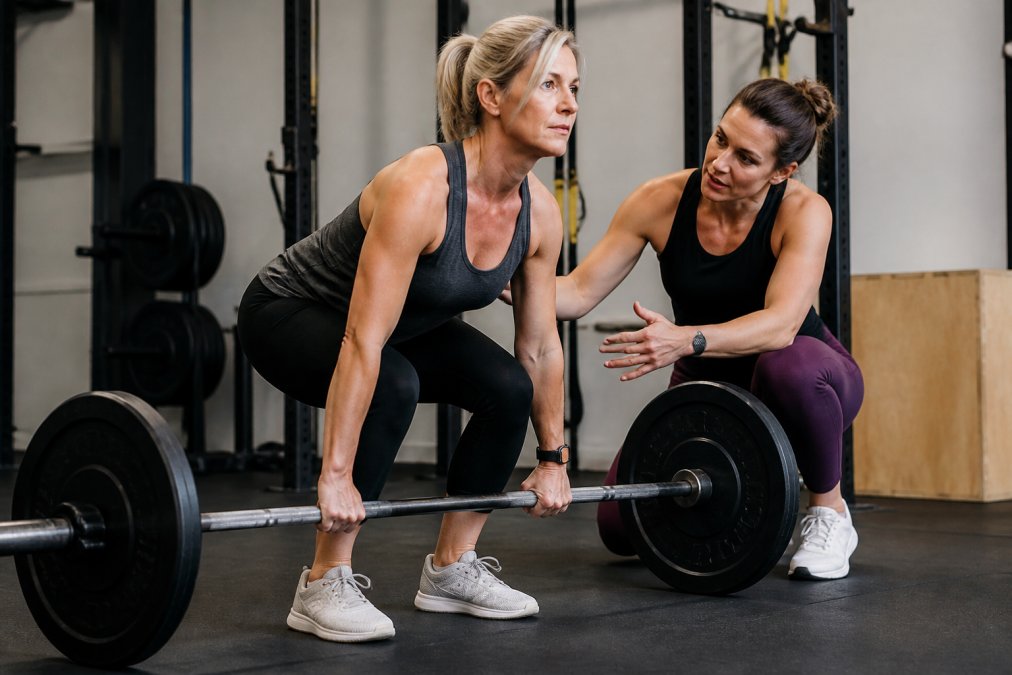
Total Time: 8-12 weeks to build a confident base Difficulty: Beginner to intermediate
What You'll Need
- Access to a barbell, dumbbells, or kettlebells
- A coach or experienced eye for the first few weeks
- A log to track loads and reps
Step 1: Master the Six Core Lifts [Time: 2-3 weeks]
Learn the hinge (deadlift, Romanian deadlift), the squat, the push, the pull, the carry, and the press. Bodyweight or light load only. Your only job here is pattern and control.
Expected Result: You can complete each movement with consistent form and no pain.
Step 2: Add Load Progressively [Time: Weeks 3-8]
Once form is solid, add weight each week. A common approach is a small increase every session or two, then hold when form breaks down. Reps drop as load rises: 8-10 reps becomes 5-6.
Expected Result: You're lifting noticeably heavier than week one with the same clean technique.
Step 3: Build in Recovery [Time: Ongoing]
Two to three lifting sessions per week is plenty for most women. More is not better if you're not recovering. Sleep, protein, and stress management are part of the program, not extras.
Expected Result: You feel stronger session to session, not depleted.
Bone Density Exercises for Perimenopause: What to Prioritize
If bone density is your priority, not all exercises are equal. Prioritize movements that load the spine and hips directly, because those are the sites where fractures cause the most damage later.
Top priorities:
- Deadlifts and Romanian deadlifts for the spine, hips, and posterior chain
- Back squats and front squats for the hips and spine
- Loaded carries (farmer's carries, suitcase carries) for the spine and grip
- Overhead presses for the shoulders and upper spine
- Step-ups and split squats for single-leg strength and hip loading
What to deprioritize: machine-based isolation work, endless cardio, and light dumbbell circuits. They have a place, but they won't build bone.
Learn more about HER Aligned here →
The Bone Health and Osteoporosis Foundation guidance on exercise emphasizes weight-bearing and muscle-strengthening activity as core to bone health. That's the framework to build your week around.
Building a Sustainable Heavy Lifting Practice for Life
The women who keep their strength for decades aren't the ones who train hardest for six weeks. They're the ones who never stop. That's a behaviour problem, not a program problem.
What derails most women isn't the lifting. It's the all-or-nothing thinking underneath it. One missed session becomes a missed week, which becomes "I've fallen off," which becomes quitting entirely. Sound familiar? That pattern is exactly what keeps women cycling through plans they never finish.
A sustainable practice looks like this:
- Two to three sessions a week, protected in your calendar
- Loads that progress, not perfection
- A plan that flexes when life gets messy, not one that collapses
This is where structured support matters. Knowing what to do is not the same as doing it consistently when your schedule is chaos and your inner critic is loud. That gap is where coaching earns its place, and it's the work Coach Justine does with women every day.
The challenge isn't figuring out whether heavy lifting is safe. It's building the structure, the habits, and the mindset that keep you lifting when motivation fades. That's the difference between a six-week experiment and a body you trust for life.
If you're ready to stop starting over, start with the Free Peri Protocol to see exactly where your training, nutrition, and mindset patterns are holding you back. From there, HER Aligned Coaching Membership gives you the structure, progressive programming, and behaviour support to build strength that lasts. Apply for 1:1 Coaching if you want the deepest level of personal guidance.
Frequently Asked Questions
Is heavy lifting safe for women in perimenopause?
Yes, for most women. Meta-analyses and systematic reviews consistently show that resistance training is safe and effective for maintaining and building bone density during perimenopause. The key is proper form, progressive loading, and working with a coach who understands your individual history. If you have osteoporosis, a fracture history, or joint issues, you need medical clearance and modified programming first.
How does resistance training affect bone density during perimenopause?
Bone responds to mechanical load. When you lift heavy, the stress placed on bone triggers remodeling, which means your body lays down new bone tissue. During perimenopause, oestrogen decline accelerates bone loss, so this mechanical stimulus becomes even more important. Research shows that progressive resistance training can slow bone loss and in some cases increase bone mineral density at the spine and hip.
How much weight should I lift to improve bone density?
The research points to loads above 70 to 80 percent of your one-repetition maximum for the exercises targeting bone health. In practice, that means lifting a weight you can manage for 5 to 8 reps with good form before fatigue. You do not need to max out. What matters is that the load is heavy enough to challenge your skeleton and that you increase it over time through progressive overload.
Can you build bone density after 40?
You can. Bone is living tissue that remodels throughout life. While peak bone mass is reached in your late 20s, resistance training and adequate nutrition can still stimulate bone formation after 40. The principles are the same: lift progressively, eat enough protein and calcium, and stay consistent. The earlier you start, the more you protect against future loss.