 listicle
Psychology-First Alternatives to Fitness Apps
Table of Contents
- Why Standard Fitness Apps Miss the Real Problem
- Understanding Food Noise and Self-Sabotage
- Overcoming All-or-Nothing Eating Patterns
- Cognitive Behavioural Techniques for Eating Awareness
- Non-App Alternatives: Somatic Awareness and Journaling
- Coaching-Based Approaches vs. App-Based Solutions
- Building Sustainable Change Without Quantification
- Conclusion
Last Updated: August 16, 2026
Why Standard Fitness Apps Miss the Real Problem
You've downloaded the app. You've logged your meals. You've tracked your steps. Three weeks in, you're exhausted by the constant quantification, you've binged on foods you'd "forbidden", and you're back to square one wondering why willpower alone never works.
Standard fitness apps miss what actually drives your choices: the psychological patterns underneath your eating and self-sabotage. They measure what you do, but they don't address why you do it. Food noise isn't solved by better tracking. It's solved by understanding the thinking patterns that create it in the first place. This is where alternatives to fitness apps that focus on the psychology of food noise and self-sabotage become essential.
At Coach Justine, we've worked with over 600 perimenopausal women who've cycled through apps, meal plans, and personal trainers only to find themselves back where they started. The common thread? None of those solutions addressed the root causes: perfectionism disguised as consistency, emotional eating paired with all-or-nothing thinking, and a fundamental lack of self-trust around food and follow-through.
The real issue isn't the app. It's that you're trying to think your way out of a behavioural and emotional problem. Food noise persists because you haven't changed the patterns that generate it. Self-sabotage happens because you're stuck in cycles where you either follow a plan perfectly or abandon it entirely. No amount of calorie counting changes that.
Understanding Food Noise and Self-Sabotage
Food noise is the constant mental chatter about food: what you should eat, shouldn't eat, will eat later, shouldn't have eaten. It's the voice that makes eating decisions feel exhausting rather than intuitive. For many women, especially during perimenopause, food noise intensifies because hormonal shifts amplify emotional regulation difficulties, and you've spent years internalising the belief that controlling food is the path to control over your body.
Self-sabotage follows a predictable pattern. You commit to a plan (the app, the rules, the tracking). You follow it perfectly for a while. Then something small happens: a stressful day, a social event, a moment of fatigue. Your all-or-nothing thinking kicks in. Since you can't be perfect, you abandon the plan entirely. You binge or eat without awareness. Then shame arrives, and you either restart the cycle or give up altogether.
Here's what most guides get wrong: they treat food noise and self-sabotage as willpower problems. They're not. They're thinking problems. Your definition of consistency is actually perfectionism. Your belief that one slip means you've failed keeps you stuck in all-or-nothing patterns. Your emotional eating isn't a character flaw; it's a coping mechanism you've relied on because you haven't developed other ways to regulate difficult emotions.
Quantification through fitness apps often worsens both issues. Tracking reinforces the idea that food is something to control rather than something to develop awareness around. It can intensify food noise by making every eating decision feel like it requires data input and moral judgment. For women with a history of rigid dieting or disordered eating patterns, tracking can trigger the exact behaviours you're trying to move away from.
Overcoming All-or-Nothing Eating Patterns
All-or-nothing thinking is the belief that you're either completely on track or completely off it. There's no middle ground. One biscuit means you've blown your diet. One missed workout means you're lazy. One day of eating without tracking means you've failed. This thinking pattern keeps you cycling between restriction and abandonment, never building sustainable habits because sustainable habits require flexibility and self-compassion.
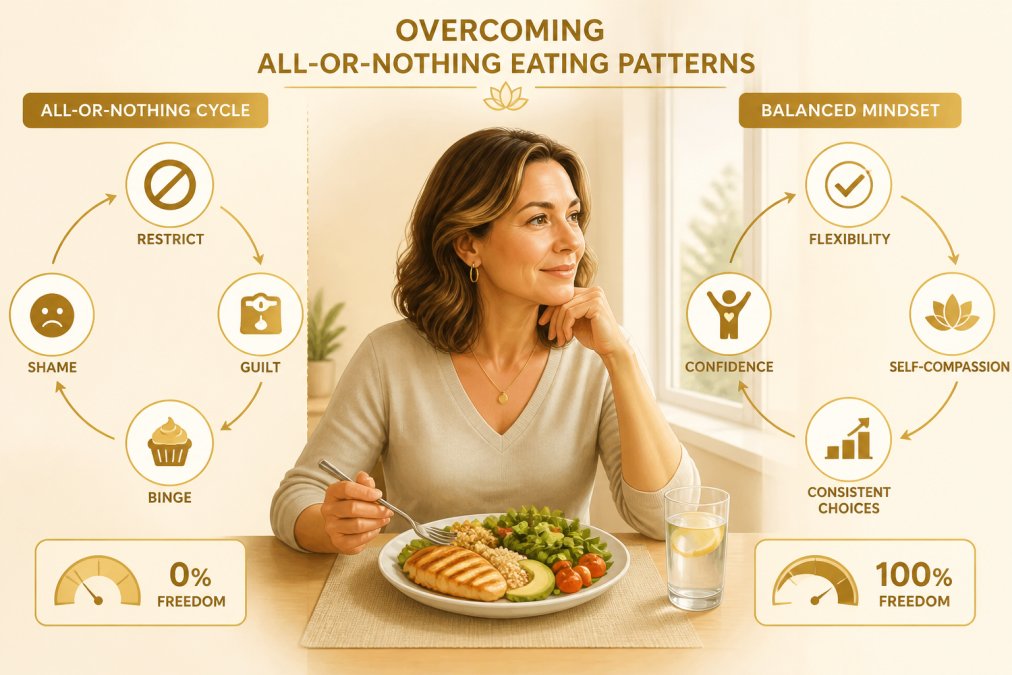
To move beyond all-or-nothing eating, you need to build a different relationship with flexibility. This isn't about being less disciplined. It's about being more intelligent about how you approach consistency.
Start by noticing when all-or-nothing thinking appears. You'll recognise it by the language: "I've already messed up, so I might as well..." or "I need to be perfect or there's no point." When you catch that thought, pause. Ask yourself: is this true, or is this my perfectionism talking? Often it's perfectionism. Your brain is trying to protect you by demanding control, but that control is what's keeping you stuck.
Next, redefine consistency. Consistency doesn't mean doing the same thing every single day. It means showing up for your goals in a way that fits your actual life, which is messy and unpredictable. Some weeks you'll eat with full awareness. Some weeks you'll eat on autopilot because you're managing a crisis at work or your kids are sick. Both are consistent with being someone who cares about her health. Consistency is the long-term direction, not the daily perfection.
Build flexibility into your eating awareness. Rather than tracking every meal, practice noticing a few meals per week without judgment. How do you feel after? What were you thinking about before you ate? Were you physically hungry or emotionally triggered? This develops awareness without the rigidity that amplifies food noise.
Cognitive Behavioural Techniques for Eating Awareness
Cognitive behavioural techniques for eating awareness work by interrupting the automatic link between a trigger (stress, boredom, fatigue, emotion) and your eating response. Rather than trying to control what you eat, you're building awareness of why you're eating and what you actually need.
The first technique is thought records. When you notice food noise or the urge to eat without hunger, write down three things: the situation (what just happened), the thought (what your mind said), and the emotion (what you felt). Example: Situation: finished a difficult meeting. Thought: "I've failed, I'm not good enough." Emotion: shame and anxiety. Response: reached for biscuits to numb the feeling.
Once you've written it down, you can see the pattern. The eating wasn't about hunger. It was about avoiding the emotion underneath. From there, you can ask: what would actually help me right now? Sometimes it's a walk. Sometimes it's calling a friend. Sometimes it's sitting with the feeling for five minutes without trying to fix it.
The second technique is behavioural activation. Food noise and self-sabotage intensify when you're isolated, tired, or not moving your body. Behavioural activation means scheduling specific activities that improve your mood and energy: walking, strength training, time with people you enjoy, creative pursuits. These aren't punishments for eating. They're ways of building a life that feels good enough that you don't need food noise to fill the gaps.
The third technique is exposure and response prevention. If you've been avoiding certain foods because you believe you can't control yourself around them, the avoidance actually strengthens the belief. Instead, you practice being around those foods without eating them (exposure) and without engaging in compensatory behaviours like restricting the next day (response prevention). Over time, the food loses its power because you've proven to yourself that you can make a choice about it.
These techniques work because they address the thinking and emotional patterns underneath your eating, not just the eating itself.
Non-App Alternatives: Somatic Awareness and Journaling
Somatic awareness means developing sensitivity to what your body is actually telling you: hunger signals, fullness signals, emotional sensations, tension, energy levels. This is the opposite of the dissociation that rigid tracking creates. When you're constantly measuring and quantifying, you lose touch with your body's own feedback system.

To build somatic awareness, start with a simple practice: before eating, pause and check in with your body. Are you physically hungry (stomach sensations, low energy, difficulty concentrating) or are you eating for another reason (emotion, habit, boredom, fatigue)? This isn't about judging either answer. It's about developing the skill of noticing.
Learn more about HER Aligned here →
During eating, pause halfway through. How does the food taste? Are you still enjoying it? What's your fullness level on a scale of one to ten? This builds the habit of eating with awareness rather than on autopilot. Over time, your body's signals become reliable guides rather than something you need an app to interpret.
Journaling is a non-quantified way to develop eating awareness. Rather than logging calories or macros, you write: what did I eat, what was I thinking about, what emotion was I managing, how do I feel now? This creates a narrative record of your patterns without the rigidity of numerical tracking.
The practice of journaling also interrupts the shame cycle. When you write without judgment, you're developing curiosity about your patterns rather than criticism. You're asking "why did this happen?" rather than "why am I so bad at this?" That shift in mindset is what changes behaviour long-term.
Somatic awareness and journaling work together. Journaling gives you a place to process emotions and patterns. Somatic awareness gives you the real-time skill to notice what's happening in your body and choose differently in the moment.
Coaching-Based Approaches vs. App-Based Solutions
The fundamental difference between coaching and app-based solutions is this: apps give you a system to follow. Coaching changes the thinking patterns underneath your choices so you don't need a system anymore.
Apps are external structures. They tell you what to do, when to do it, and how to measure it. They work well if your problem is lack of information or lack of structure. But if your problem is self-sabotage, emotional eating, perfectionism, or food noise, an external structure won't solve it. You'll follow the structure until something stressful happens, then you'll abandon it because the structure doesn't address why you sabotage yourself in the first place.
Coaching addresses the patterns that drive your choices. A coach helps you identify why you binge, why you restrict, why you cycle between extremes. She helps you understand that your perfectionism feels like discipline but actually keeps you stuck. She helps you develop self-trust by showing you that you can make choices aligned with your values even when it's hard.
With coaching, you're building internal capacity, not external dependence. You're learning to manage your mind, regulate your emotions, and make decisions that feel good to you. That's why women who work with coaches keep their results. They've changed the thinking patterns underneath their behaviours.
This doesn't mean coaching is therapy dressed up as weight loss. It means coaching addresses the psychological and behavioural factors that determine whether you keep weight off or gain it back. It's practical, focused, and results-oriented.
Building Sustainable Change Without Quantification
Sustainable change happens when you develop skills and awareness, not when you follow a plan perfectly. The moment you stop following the plan, everything reverts. But when you've developed the skill of eating with awareness, the skill of managing emotions without food, the skill of moving your body because it feels good, those skills stay with you.
Building sustainable change without quantification means shifting from external measurement to internal feedback. Instead of asking "did I hit my targets?", you ask "do I feel good? Do I have energy? Am I at peace with food? Do I trust myself?"
This requires patience because it's slower than rapid weight loss from restriction. But it's faster than the cycle of losing and regaining the same weight repeatedly. Women who've spent years in that cycle often find that sustainable change, even if it's gradual, feels like freedom compared to the exhaustion of constant restriction and abandonment.
The practices that build sustainable change are the ones that develop awareness and skill: eating with attention, moving in ways that feel good, journaling to understand your patterns, practising flexibility with food, developing other ways to manage emotions, building self-trust through keeping small promises to yourself.
These practices don't require an app. They require consistency and self-compassion. They require you to believe that slow, sustainable change is better than fast, temporary change. For most women, especially those who've spent years cycling through diets, that belief shift is the hardest part. Once you make it, everything else becomes possible.
You've tried the apps. You know how the cycle works. You download, you follow perfectly for a while, something happens, you abandon it, shame arrives, you restart. The reason that cycle keeps repeating is that apps don't address the thinking patterns that created it.
Coach Justine works differently. Over 12 years, she's helped over 600 perimenopausal women break out of yo-yo dieting and plan-dependence by changing the patterns that actually drive their choices and behaviours. She uses evidence-based mindset coaching, trauma-informed approaches, and strength training to address the root causes: perfectionism, self-sabotage, emotional eating, and lack of self-trust.
Her clients don't just lose weight. They become women who keep it off for life because they've changed how they think about themselves, food, and their bodies. If you're ready to move beyond apps and actually address the psychological patterns keeping you stuck, start with the Free Peri Protocol to understand your specific patterns, or explore the HER Aligned Coaching Membership to work with Justine directly on the thinking and behaviours that matter.
Frequently Asked Questions
How does food noise impact long-term weight management?
Food noise is the constant mental chatter about what you should eat, shouldn't eat, or could eat. It drains your cognitive resources and keeps you locked in a cycle of restriction and overeating. When you're managing food noise, you're not actually managing your weight; you're managing your thoughts. This is why standard fitness apps fail: they add more data to track instead of quieting the noise itself. Long-term weight management becomes sustainable only when food noise decreases, which happens through addressing the underlying beliefs and self-sabotage patterns driving it, not through calorie counting.
What is the psychological difference between tracking and awareness?
Tracking is external surveillance: you log calories, steps, or macros to monitor behaviour from the outside. Awareness is internal recognition: you notice your hunger cues, fullness signals, emotional triggers, and patterns without quantifying them. Tracking often increases anxiety and rigidity, especially in women prone to all-or-nothing thinking. Awareness builds trust in your own body and reduces the psychological burden of constant measurement. The shift from tracking to awareness is where real change happens because it addresses the root cause: your relationship with your body and food, not the numbers themselves.
How do I identify self-sabotage in my eating habits?
Self-sabotage shows up as specific patterns: you commit to a plan, follow it perfectly for days, then abandon it completely over one perceived mistake. You eat in secret or quickly when no one is watching. You tell yourself you'll start Monday, then use the weekend as permission to binge. You lose weight, then unconsciously regain it within months. You know exactly what to do but don't do it, then feel shame. These patterns aren't laziness or lack of willpower; they're psychological protection mechanisms rooted in perfectionism, control, or unprocessed emotions. Identifying them means noticing the exact moment the pattern triggers, not judging yourself for it.
Are there evidence-based ways to quiet food noise without medication?
Yes. Cognitive reframing, somatic awareness exercises (like conscious breathing and body scanning), and structured journaling address the thoughts and emotions driving food noise. Behavioural strategies like eating without distraction, pausing before eating to identify actual hunger, and practising self-compassion when you overeat all reduce noise over time. Coaching that addresses the beliefs underneath your eating (perfectionism, control, unworthiness) creates lasting change. These approaches require consistency and self-awareness, but they build the mental skills that keep the noise quiet long-term, unlike apps which quieten it only while you're actively using them.