 Ultimate guide
Strength Coaching for Women Over 40: Why Plans Alone Fail
Last Updated: November 19, 2026
Quick Summary
Strength coaching for women over 40 is one-to-one support that assesses your training history, adapts movement around injuries and symptoms, and builds the habits that keep you consistent when life gets busy. Plans alone usually fail because they cannot see you through a hard week. A good coach works on the self-trust and setback handling that make results last.
- Two to three full-body sessions a week is a sensible starting point for most women.
- Good coaching begins with an assessment of training history, injuries, energy and schedule.
- Strength coaching should adapt the movement, not drop the goal, around injuries or pelvic-floor symptoms.
- Progress should be tracked through strength, sessions attended and sleep, not the scale alone.
- Ask how a coach handles bad weeks and missed sessions before you commit.
Table of Contents
- Why a Better Training Plan Is Rarely the Missing Piece
- What Strength Training Does for Women in Perimenopause
- How Often Should Women Strength Train?
- Starting a Beginner Strength Training Programme for Women
- What Strength Coaching for Women Over 40 Should Include
- Online Strength Coaching for Women: What to Expect
- Deciding Whether Strength Coaching Is Your Next Step
- Frequently Asked Questions
Why a Better Training Plan Is Rarely the Missing Piece
If you have been strength training on and off for years, you probably know the basics. Squat, hinge, push, pull, eat enough protein, lift a bit heavier each month.
Many women over 40 have tried programme after programme, and most worked for a while. What was missing was the part that holds when life gets messy.
A plan is external. It tells you what to do on a Tuesday at 6am.
So before you look for the next programme, ask a different question: what do I need to build in myself so this result actually holds?
What Strength Training Does for Women in Perimenopause
Strength training matters more in perimenopause, not less. Muscle is one of the most useful tissues you have for metabolic health, daily function and carrying yourself with confidence as you age. Resistance work helps preserve and build lean muscle, supports bone density and makes everyday tasks feel easier.
Recognised exercise guidelines consistently identify resistance training as a key way to maintain muscle and bone mass with age.
Hormonal change is part of this stage of life, but it is not a reason to fear strength training or to assume your body has stopped responding. Women who lift consistently can keep getting stronger and more capable through this stage of life.
How Often Should Women Strength Train?
For most women starting or returning to strength work, two to three sessions a week covering the major movement patterns is a sensible foundation. Full-body sessions are easier to sustain than complicated splits when your schedule is unpredictable. Build in rest days between sessions.
The frequency that works is the one you can keep doing. Four sessions a week that you abandon in three weeks produces less than two sessions a week you still do in three months. Start where you can realistically succeed, then build.
The right frequency is the one you can keep up through busy and low-energy weeks, and the article gives these starting points.
| Factor | Guidance | Note |
|---|---|---|
| Sessions per week | Two to three | Full-body sessions for most starting out |
| Rest between sessions | Rest days between each session | Recovery is built into the week |
| Session pattern | Full-body rather than complicated splits | Easier to sustain when schedules are unpredictable |
| Best frequency | The one you can sustain | Four sessions abandoned in three weeks gives less than two kept for three months |
Starting a Beginner Strength Training Programme for Women
If you are starting from scratch or coming back after a long break, begin with bodyweight and light resistance so you can learn movement quality before adding load. Focus on a handful of foundational exercises: a squat or sit-to-stand, a hip hinge, a push, a pull and some carries. Add weight gradually, and keep a simple record so you can see progress over weeks rather than days.
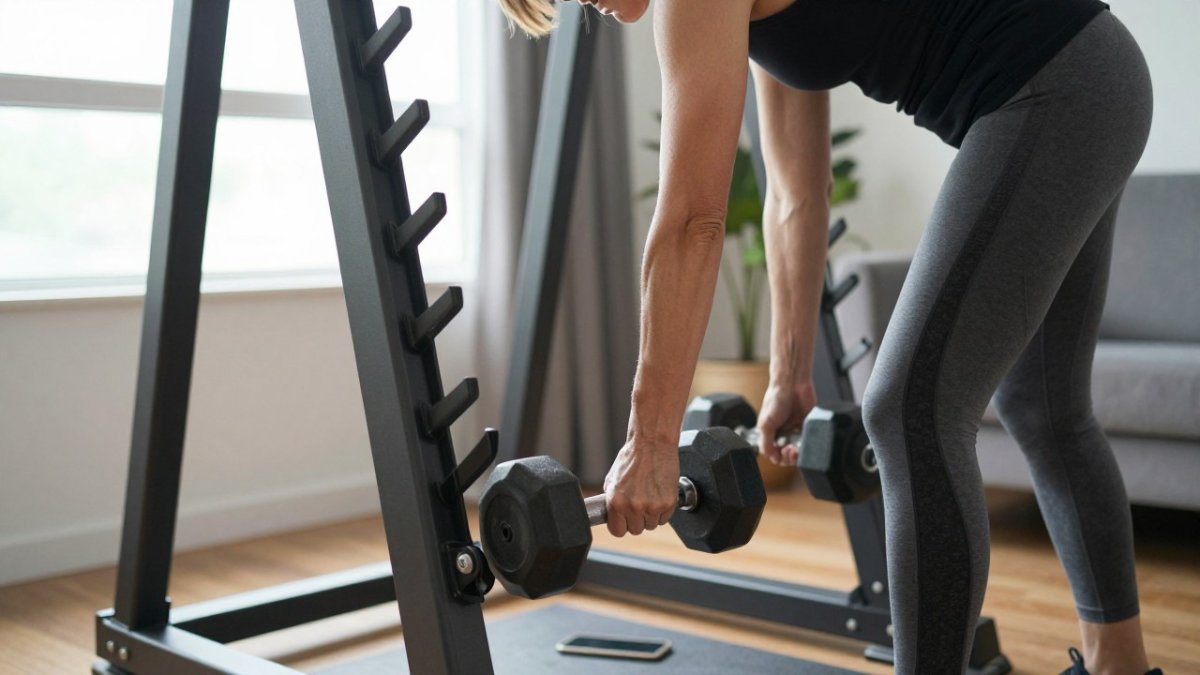
A beginner programme should feel challenging but repeatable. If you finish every session wrecked and dread the next one, the plan is not working for you.
!A woman in her forties in activewear loading a dumbbell onto a home rack in a bright living room, with a phone propped nearby
What Strength Coaching for Women Over 40 Should Include
Good strength coaching goes beyond a list of exercises. It starts with an assessment of where you are now: training history, injuries, energy patterns, schedule and what you have tried before.
Strong programming for women in midlife also accounts for the stage of perimenopause you are in and any health conditions or old injuries. It should teach you to adjust on a low-energy week rather than abandoning everything.
If you want to see which exercises belong in a programme like this, see our guide to the best strength training exercises for perimenopause to judge what a coach should be building.
Coach Justine works with women to build exactly this kind of foundation. If you are weighing up whether personalised support is the right next step, the HER Aligned Perimenopause Coaching membership is one place to look at how that kind of structure is set up.
What the assessment should actually cover
A useful assessment is not a fitness test. It is a conversation and a short practical screen. Expect questions about your training history, current niggles, sleep, perimenopausal symptoms, your working week and what has derailed you before. Expect a coach to watch you move through a squat, a hinge, a push and a pull, and to ask about pelvic-floor symptoms such as leaking when you jump, cough or lift heavy.
Watch out: if a coach hands you a programme before asking any of this, you are buying a template, not coaching.
How programming shifts across perimenopause stages
The principles of building muscle do not change because you are over 40. Progressive overload, adequate protein, sufficient recovery and consistency still do the work. What changes is the context around those principles.
In perimenopause, cycle length and symptom patterns can vary month to month, so a plan benefits from flexibility rather than a rigid weekly template.
In post-menopause, the priority often shifts towards maintaining and building bone and muscle, so loading becomes non-negotiable rather than optional. A coach should be comfortable progressing loads over months, not just keeping you moving.
Adapting around health conditions and injuries
Most women over 40 arrive with something: an old knee injury, a sore shoulder, low bone density, joint pain or pelvic-floor symptoms. Good coaching adapts the movement, not the goal. A hip hinge can become a box squat or a cable pull-through. A barbell press can become a landmine press.
If you have diagnosed osteoporosis, a recent fracture, significant pelvic-floor symptoms or a joint that is actively painful, that is a conversation for your GP or physiotherapist first. A strength coach should work alongside that advice, not replace it.
Measuring progress beyond the scale
Useful progress measures go beyond weight. These include the load you can lift for a given number of reps, how many sessions you actually attended over a month, how your sleep and energy track across a training block, and whether everyday tasks feel easier.
Online Strength Coaching for Women: What to Expect
Online coaching can work well for busy women, especially when it includes personalised programming and regular check-ins rather than a generic video library. Expect to be asked about your history and current life before you are given a plan.
Be cautious with any programme that promises fast results or relies on before-and-after photos alone. Look instead for evidence of lasting outcomes and clear support for the moments when life gets in the way. Ask how the coaching handles setbacks, and whether it teaches you to apply the plan independently over time.
What a good online coaching relationship looks like week to week
A well-run online programme has a clear rhythm, so you know how check-ins work and what happens when you miss a week.
Watch out: if check-ins are one-way forms that nobody responds to, you are paying for an app, not coaching.
Questions to ask before you commit
A short list of questions will tell you more than any sales page:
- What are your qualifications, and are you insured to coach strength training?
- How do you assess a new client, and what happens in the first two weeks?
- How do you adapt a programme around injuries, pelvic-floor symptoms or a diagnosis such as osteoporosis?
- How do you measure progress beyond weight, and how often do we review it?
- What happens when I have a bad week or miss sessions?
- How do you handle the mindset side, not just the training?
- Can I see examples of clients who have stayed consistent for a year or more?
A coach who cannot answer these clearly is not the right fit, however good the marketing looks.
Comparing the formats you are likely to encounter
Online coaching sits alongside a few other options, and each suits a different woman.
A generic app or video library is cheap and flexible, but it cannot see you, adapt to your week or notice when you are drifting.
A small-group online programme offers community and accountability at a lower level of individual attention. It suits women who are motivated by others and do not need every session tailored.
One-to-one online coaching offers the most individualisation: assessment, programming, feedback and support through setbacks. If that sounds like you, you can apply for 1:1 coaching to see whether it fits your situation.
None of these is inherently better. The right choice depends on what has stopped you before.
What to expect from Coach Justine's online coaching
Coach Justine's approach to this is built around the same principle: lasting results need the internal foundation, not just the plan.
Deciding Whether Strength Coaching Is Your Next Step
If you have tried programmes before and keep ending up back where you started, the next step may not be another plan. Read whether online perimenopause coaching is worth paying for compared with doing it alone.
You can start by taking the free Peri Protocol Assessment to see whether personalised coaching fits where you are right now.
Either way, the goal is the same: to stop starting over and become the woman who can keep her results.
Frequently Asked Questions
How often should women over 40 strength train? Most women starting out do well with two to three full-body sessions a week, with rest days between them. The right frequency is the one you can sustain through busy and low-energy periods.
Is strength training safe during perimenopause? For most women, progressive resistance training is safe and beneficial during perimenopause.
Can I do this without a coach? You can absolutely train alone.
How long before I see results from strength training? Changes in strength and energy can appear within a few weeks, while visible changes in muscle and body composition take longer.
Frequently Asked Questions
Is strength training effective for women over 40?
Yes. Resistance training is one of the most consistent ways to build and maintain muscle, strength and functional capacity in midlife. The evidence from recognised exercise guidelines shows that progressive strength work supports bone density, balance and metabolic health, and these benefits continue to accrue well past 40. The useful question is rarely whether it works. It is whether you can keep doing it through busy weeks, stress and low-energy days, which is where most women's training breaks down.
How often should women over 40 do strength training?
Most adults are advised to do muscle-strengthening activity at least two days a week, working all the major muscle groups, according to Australia's physical activity guidelines. Two sessions a week is a sound starting point for most women, with more added once the routine feels stable. The key is a frequency you can repeat during a demanding month, because a plan that survives only in a good month will not produce lasting results.
Can women build muscle after 40?
Yes. Women in their forties, fifties and beyond can add strength and muscle with progressive resistance training, and many do so within a few months of consistent work. The principles remain the same as at any age: gradually increase load or effort over time, train with sufficient challenge, and allow recovery. What changes is often the context, such as lower recovery capacity during stressful periods, which is why programming needs to flex rather than be rigid.
Is online strength coaching suitable for beginners?
It can be, particularly when the coaching addresses both the training and the habits around it. Good online coaching begins with an assessment of your current capacity, goals and constraints, then builds a programme you can follow at home or in a gym with clear technique guidance and regular feedback. Beginners often do best when they are taught how to adjust sessions on harder days rather than abandoning them entirely.